

Boost Local Growth with small business seo uk: Practical Guide
Think of small business SEO in the UK as your direct line to growth. It's all about connecting you with local customers at the exact moment they're searching online for what you offer. This isn't about paying for every single click; it's about optimising your website to rank higher in search results, making your business impossible to miss and driving a steady stream of high-quality traffic your way.
Why SEO Is So Important For UK Small Businesses
For many small businesses in the UK, finding new customers can feel like a game of chance. You might be getting by on word-of-mouth or the occasional social media win, but those methods rarely provide a consistent flow of leads. This is where Search Engine Optimisation (SEO) completely changes the game. It transforms your website from a simple online brochure into a predictable, lead-generating powerhouse.
It’s not about trying to trick Google. It’s about genuinely proving that you are the best, most relevant answer to a potential customer's question.
When someone in your local area searches for a service you provide—whether that’s an "emergency plumber in Poole" or an "artisan bakery in Bristol"—SEO is what puts your business front and centre. Being visible in that moment of need is incredibly powerful. It builds immediate trust and is often the final push that leads to a phone call or someone walking through your door.
The Real-World Impact of Being Seen
The UK economy is built on the back of small businesses. In fact, they account for a staggering 99.9% of all businesses, which adds up to around 5.9 million individual enterprises. In such a crowded market, simply getting noticed is half the battle.
The good news is, business owners are catching on. A recent survey found that 89% of small business owners see a direct link between their SEO efforts and business growth, while 92% consider their website their single most effective marketing tool. It’s clear the mindset has shifted: a strong online presence isn’t just a "nice-to-have" anymore; it's a fundamental part of any modern business strategy.
Your Actionable Path to Growth
Getting started with SEO doesn’t need to be some monumental, complex task. It’s really about taking small, consistent actions that build on each other over time.
This timeline gives you a realistic idea of what that journey looks like—from the initial work to seeing tangible results.
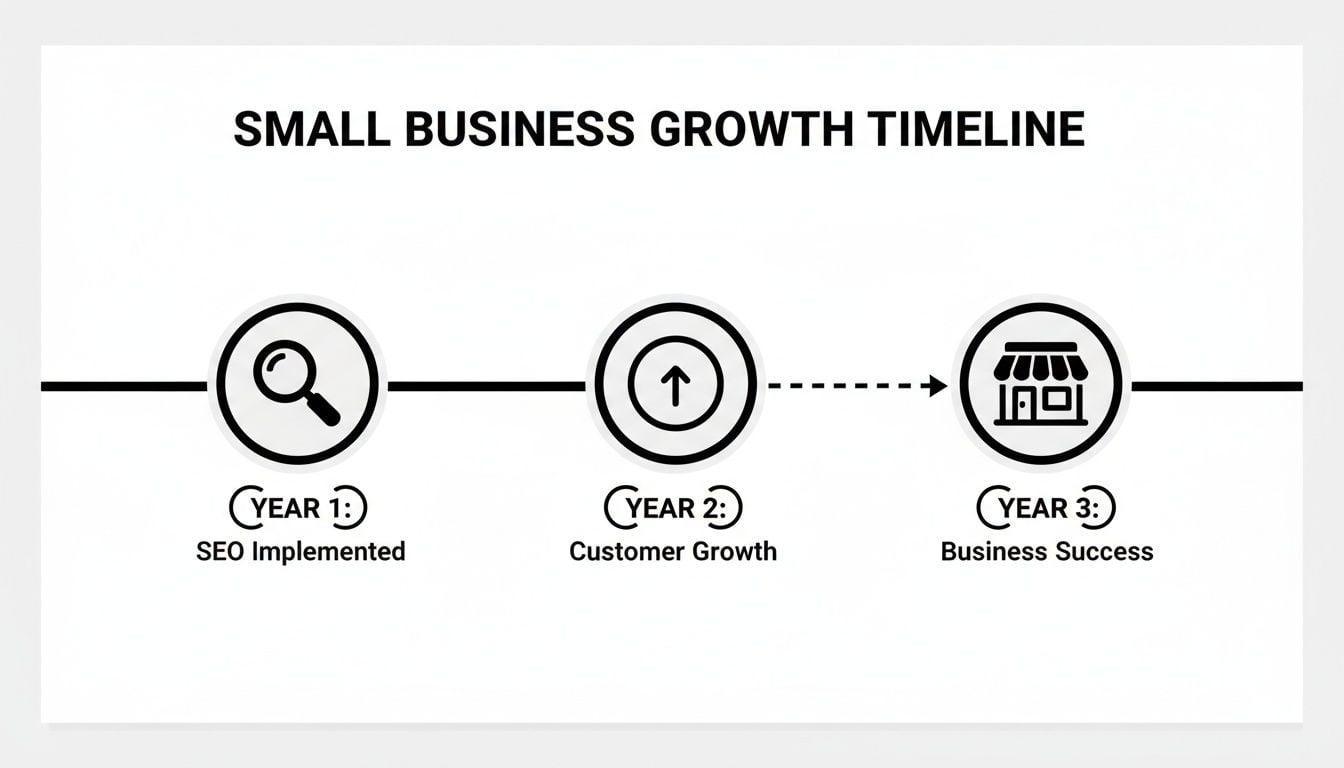
The key thing to remember is that SEO is a marathon, not a sprint. Your early efforts lay the groundwork for gradual customer growth, which ultimately leads to measurable success for your business.
A great starting point is getting familiar with the right tools for the job. You can explore some of the best SEO software for small businesses to see what's out there, as many offer free trials or affordable plans to get you going.
Here is a simple, actionable list to kickstart your SEO journey today:
- Claim Your Google Business Profile: Go to google.com/business and claim your free profile. Think of this as your digital shopfront. Make sure every detail is correct, upload high-quality photos, and actively encourage customer reviews. It's the single most impactful thing you can do for local visibility.
- Identify Your Core Keywords: Put yourself in your customers' shoes. What words and phrases would they type into Google to find a business like yours? Brainstorm a list of 5-10 core terms (e.g., "plumber in Weymouth," "Dorset wedding photographer").
- Weave Keywords Into Your Website: Naturally work these keywords into your homepage and service pages. Don't stuff them in unnaturally; just make sure your website clearly states what you do and where you do it.
- Test Your Website on Mobile: Open your website on your phone. Is it easy to read? Can you click buttons without zooming in? If your site is a pain to use on a small screen, you’re losing customers. It's that simple.
By concentrating on these fundamentals, you’re building a solid foundation. At its heart, good SEO for a small UK business is all about positioning yourself as the most helpful and relevant local choice. Every small tweak is a step in the right direction.
This guide will walk you through everything you need to know, but if you'd rather have an expert take a look, feel free to check out our dedicated search engine optimisation services.
1. Win on Your Home Turf: Local Search in Your UK Town
Before you can think about conquering the wider web, you need to win the battle right on your doorstep. For any UK small business, from a café in Weymouth to a plumber in Poole, this is where SEO gets real. It’s how you turn clicks into actual footfall and phone calls.
This all starts with getting practical. And the absolute cornerstone of any local strategy is your Google Business Profile (GBP). Honestly, if you do nothing else, do this. Think of it as your digital shopfront – for many potential customers, it’s the very first time they’ll ever see your brand. Getting it right isn't just a good idea; it's essential.
Your Google Business Profile: The Local SEO Superpower
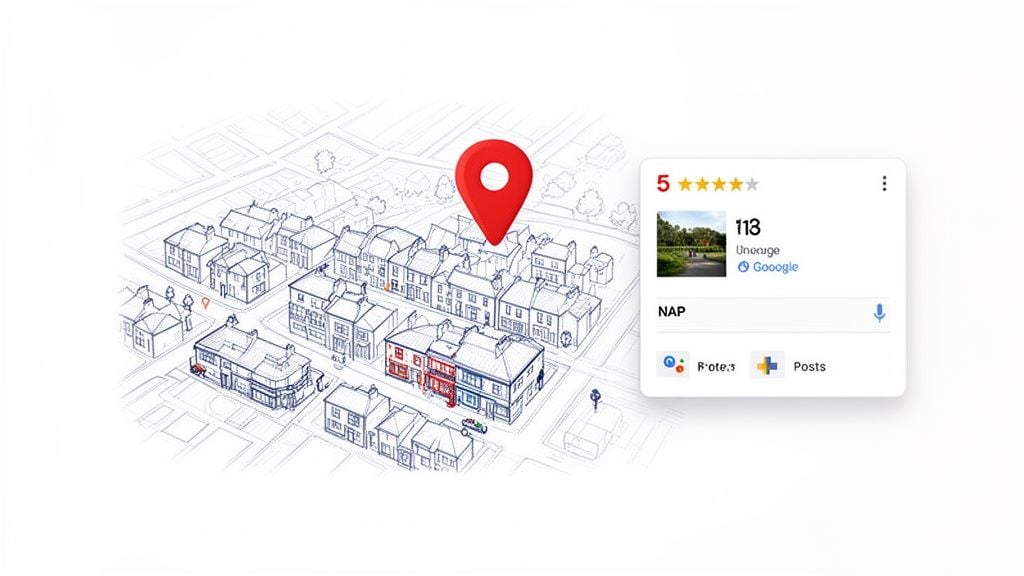
You know that box that pops up in Google Maps or at the top of the search results, showing a business's location, hours, photos, and reviews? That's your Google Business Profile. It’s an incredibly powerful tool that can be the deciding factor between a customer choosing you or the competitor down the road.
The numbers don't lie. A staggering 98% of consumers now use the internet to find information about local businesses. And when they search on their phone, 76% of people who look for something nearby will visit a business within a day. Yet, despite this, an unbelievable 56% of local businesses haven't even claimed their free Google Business Profile. That's a massive, wide-open opportunity you can't afford to miss.
Getting Your Google Business Profile in Shape
Optimising your profile isn't a "set it and forget it" job. It needs a bit of ongoing attention to keep it relevant and engaging. I’ve seen it time and time again: a well-managed profile can completely change a business's fortunes. I once worked with a local Dorset café, and just by dialling in their profile, we got them to the top spot for "best Sunday roast Weymouth."
To help you get started, I've put together a checklist to ensure your profile is fully optimised and ready to attract local customers.
Your Google Business Profile Optimisation Checklist
Use this checklist to ensure your Google Business Profile is fully optimized to attract local UK customers.
| Optimisation Area | Action Required | Why It Matters for UK SEO |
|---|---|---|
| Core Information | Fill out every section: NAP (Name, Address, Phone), website, and hours. | This is the foundational data Google uses to verify your business and show it to local searchers. |
| Categories | Select a specific primary category (e.g., "Plumber") and relevant secondary ones (e.g., "Boiler Repair Service"). | This tells Google exactly what you do, helping you show up for more specific searches. |
| Services & Products | Add your full list of services or products with descriptions and prices if possible. | Provides detailed information directly in the search results, answering customer questions upfront. |
| Photos & Videos | Regularly upload high-quality, geotagged photos of your premises, team, and work. | Visuals build trust and engagement. Geotagging reinforces your physical location to Google. |
| Customer Reviews | Actively encourage happy customers to leave reviews and respond to all of them (good and bad). | Reviews are a huge ranking factor and provide powerful social proof for potential customers. |
| Google Posts | Use Posts weekly to share offers, news, events, or blog updates. | Keeps your profile fresh and active, acting like free advertising space in search results. |
| Q&A Section | Proactively add and answer common questions your customers might have. | Controls the narrative and provides quick, helpful answers, positioning you as an expert. |
Following these steps sends all the right signals to Google: that your business is active, reputable, and the best answer for what people are searching for nearby. If you're after a more detailed walkthrough, check out our guide to free GBP optimisation.
I can't stress this enough: a fully optimised Google Business Profile is the single most impactful, highest-return activity for any local UK business starting with SEO. It's the foundation for everything else you do.
Build Local Trust with Citations
Once your GBP is looking sharp, the next piece of the puzzle is building citations. A citation is simply any online mention of your business's Name, Address, and Phone number (your NAP). You’ll find them in online directories, from big names like Yell and Thomson Local to smaller, industry-specific websites.
The golden rule here is consistency. Your NAP details must be absolutely identical everywhere they appear. Even a small difference, like "Ltd" vs "Limited" or an old phone number, can create confusion for search engines and weaken your local authority.
Think of each accurate citation as a little vote of confidence. The more trusted websites that vouch for your details, the more Google believes you are a legitimate, established business at your stated location. To really get ahead in your local market, it pays to delve deeper into comprehensive Local SEO strategies that cover every angle of geo-targeted marketing.
Your Website: The Engine of Your SEO Strategy
All your marketing efforts, from social media posts to local flyers, eventually point back to one place: your website. If that site is slow, a nightmare to use on a phone, or just plain confusing, all your hard work getting people there is wasted.
You don’t need to be a coding genius to get this right. The secret is focusing on what Google actually rewards: a fast, user-friendly, and technically sound website. Let's get into the practical, non-negotiable elements that form the foundation of great small business SEO in the UK.
Speed and Mobile-Friendliness Are No Longer Optional
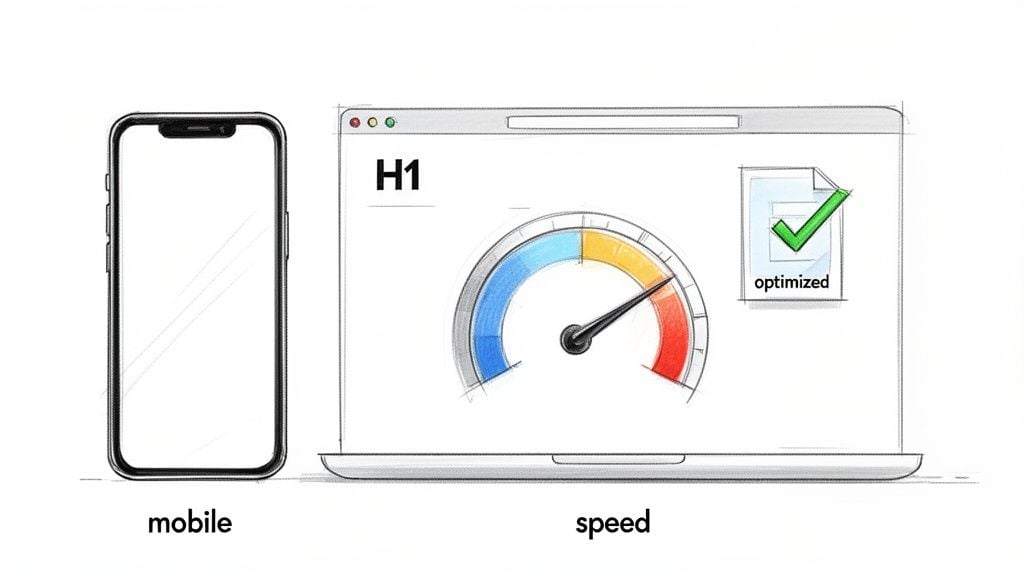
Let's be blunt: a slow website in 2026 is a broken website. People have zero patience for a page that takes forever to load. In fact, if it takes longer than three seconds, you’ve probably already lost them. This is especially true on mobile, where the majority of UK searches now happen.
Google is all-in on this. They use a “mobile-first” approach, meaning they look at your mobile site first to decide how to rank you. If visitors have to pinch and zoom to read your text or can't tap a button because it's too small, your rankings will absolutely suffer.
A slick mobile experience isn’t just a nice bonus anymore. It's a core requirement for being visible on Google. The search engine directly rewards sites that give users a fast, intuitive experience, no matter the device.
Your On-Page SEO Action Plan
On-page SEO is simply everything you do on your website pages to make them clear for both people and search engines. Here’s a practical run-down of what to focus on yourself or to go over with your web designer.
Craft Compelling Title Tags
Your title tag is the blue, clickable headline in Google’s search results. It’s your first, best chance to grab someone's attention. A good title is descriptive and gets your main keyword in early.
For a Weymouth-based bakery, a title like "Artisan Bread & Cakes in Weymouth | The Coastal Loaf" works perfectly.
Write Persuasive Meta Descriptions
This is the little blurb under the title. It doesn't directly affect your rank, but it absolutely affects whether someone clicks on your result or a competitor’s. Think of it as a mini-advert.
Summarise what the page offers and end with a gentle nudge, like "Order online or visit our bakery today."
Structure Content With Headings
Headings (H1, H2, H3, etc.) create a logical flow for your content. They break up big blocks of text, making your pages easy to scan for busy readers. They also give Google a clear map of your content's structure.
Your main page title should always be an H1. Use H2s for the main sections (like these) and H3s for the sub-points within them.
Optimise Your Images
I see this all the time: massive, unoptimised images grinding a website to a halt. It’s one of the biggest culprits of slow load times.
Before you upload any image, run it through a free tool like TinyPNG. Also, make sure your filenames are descriptive (e.g., weymouth-artisan-bakery.jpg instead of IMG_1234.jpg) and always add alt text. This short description helps screen readers and tells Google what the image is about.
Use Smart Internal and External Links
Internal links: These are links to other relevant pages on your own site. A blog post about your new cake range should definitely link to your main cake ordering page. This helps users and search engines find more of your great content.
External links: Don't be afraid to link out to other authoritative websites where it makes sense. It shows you're providing helpful, well-rounded information for your visitors.
Nailing these on-page elements is a massive step towards building a site that Google can easily crawl, understand, and ultimately, show to more potential customers. If you're starting fresh or planning a redesign, looking into a professional website design process will ensure these technical foundations are built correctly from day one.
Crafting Content That Wins Over Your Local Community
Getting your website technically sorted is a huge win, but it’s your content that will truly make you stand out. This is where you show your expertise, connect with your community, and give people a compelling reason to choose you. For a UK small business, great content isn't about aimlessly writing blog posts; it's about answering the very questions your local customers are searching for right now.
Put yourself in your customer’s shoes for a moment. They're probably not just Googling "estate agent Dorset." They're asking real questions like, "Is now a good time to sell a house in Dorchester?" or "What are the best primary schools near Poundbury?" Your content needs to be the definitive answer.
This is the secret sauce for any successful small business SEO UK strategy. By creating genuinely helpful, location-specific articles and guides, you cement your reputation as the go-to authority in your patch.
Answering the Questions Your Customers Are Actually Asking
The trick to creating brilliant local content is a simple mindset shift: stop thinking like a business owner and start thinking like your customer. What are their biggest concerns, their burning questions, their immediate needs?
Imagine you’re a tradesperson in Poole. You could write a hugely valuable article on "Common Boiler Issues in Older Parkstone Homes," immediately grabbing the attention of homeowners in that specific suburb. Right away, you’re not just a business; you’re a local expert who gets it.
This approach turns your website from a digital brochure into an indispensable local resource. When you consistently provide the answers people are looking for, you build trust long before they’re even ready to pick up the phone.
And the numbers back this up. Organic SEO is still the heavyweight champion for UK small businesses, driving 53.3% of all website traffic—a massive figure compared to just 5% from social media. That means SEO delivers over 1,000% more visitors. For many eCommerce brands, this translates to ranking for thousands of keywords and generating traffic that would otherwise cost a fortune in paid ads—a vital edge in a market where UK online retail hit a staggering £127.41 billion in 2024. You can see how these eCommerce SEO statistics demonstrate the value of a solid organic strategy.
Actionable Content Ideas for Your UK Business
Coming up with local content ideas can feel like a chore, but it’s much simpler when you focus on formats that offer real, tangible value. Here are a few tried-and-tested ideas you can run with.
In-Depth Local Guides
These pieces position you as the undisputed local expert. A Dorset estate agent could publish "The Ultimate Guide to Navigating the Dorchester Property Market," covering everything from house prices to the best local pubs and parks.Hyper-Specific Service Pages
Don't just have one generic "Services" page. Create dedicated pages for each service in every key town you cover. A landscaping company, for example, should have distinct pages for "Garden Design in Weymouth" and "Patio Installation in Portland," each optimised for those search terms.Helpful "How-To" Posts
Think about the questions you answer on the phone every single day and turn them into blog posts. A local IT support firm could write a post on "How to Boost Your Wi-Fi Signal in a Thick-Walled Dorset Cottage"—a specific problem that resonates with local residents.Local Case Studies That Tell a Story
Showcase a project you’ve completed for a local client (with their permission, of course!). Don’t just show photos; explain the customer's problem, how you solved it, and the fantastic result. A title like "A Modern Kitchen Renovation in a Bridport Victorian Terrace" is far more engaging than a generic "Our Work."Location-Specific Landing Pages
If you operate across several towns, each one deserves its own dedicated page. These pages should feel like they were written just for that community, mentioning local landmarks, neighbourhoods, and showing that you truly understand the area.
The goal is always the same: be the most helpful answer. When someone in your town searches for a solution you provide, your content should be what they find. This is how you build authority, trust, and a steady stream of local leads.
By centring your content on these practical, localised formats, you stop just chasing keywords. You start building a digital presence that reflects your deep community roots, making your business the obvious choice for customers in your area.
Practical Link Building Through Community Partnerships
When you hear the term ‘link building’, it’s easy to picture a shadowy, technical process best left to the experts. But for a small UK business, the reality is much simpler and, frankly, more wholesome. It’s all about community.
Forget the old-school, spammy tactics of buying links. The links that truly matter are the ones you earn. These are called backlinks – links from other websites pointing to yours – and they are one of the most powerful signals you can send to Google.
Think of it like a personal recommendation. If a respected local newspaper links to your bakery's website in an article about the "best cakes in town," that's a massive vote of confidence. It tells Google you’re a legitimate, trusted business, and it’s this kind of authentic endorsement we’re aiming for.
Tap Into Your Local Connections
The best place to start is right on your doorstep. You’re already part of a local ecosystem, and by simply getting more involved, you’ll find natural opportunities for other sites to link back to you.
It's all about finding partners whose audience overlaps with yours. For instance, if you're a tradesperson in Weymouth, a link from the Dorchester Chamber of Commerce or a local Dorset property blogger is worth far more than a random link from a national DIY chain.
Relevance is king here, especially when you're just starting out. This approach is fundamental to a solid small business SEO UK strategy because it helps you build a backlink profile that looks and feels completely natural to Google.
The best backlinks come from relationships, not transactions. Focus on creating genuine partnerships in your community, and the links will follow naturally as a byproduct of your good work and networking.
Community-Based Link Building Ideas You Can Use Today
Ready to start building some valuable connections? Here are a few practical ideas you can get started with this week, all centred on your local community.
Sponsor a local team or event
Whether it’s the kids' football club, a charity 5K, or the village summer fete, sponsorships nearly always result in a shout-out on the organiser's website, complete with a link. It’s a brilliant way to show you care about your community while earning a highly relevant local link.Pair up with a nearby business
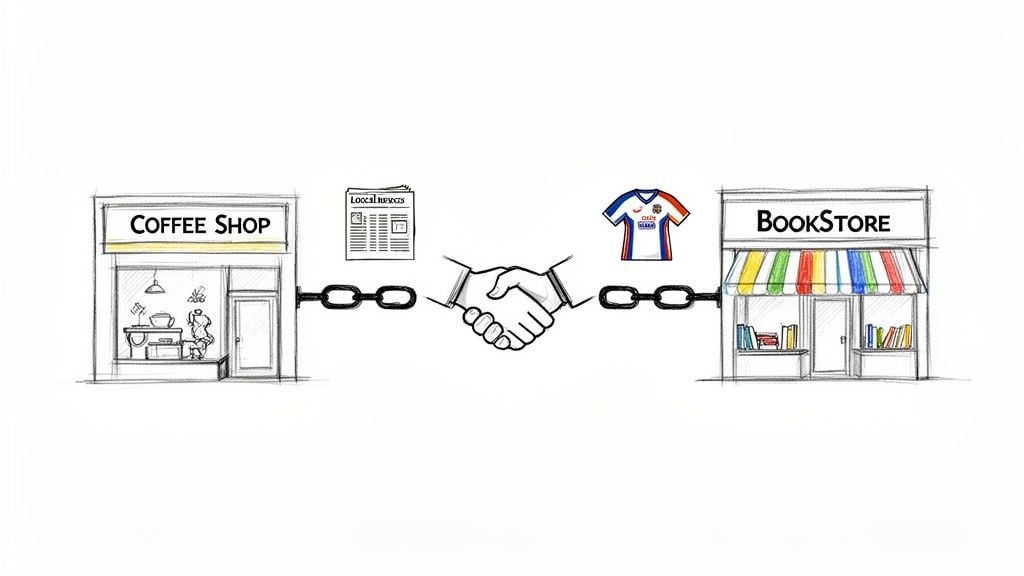
Find a non-competing business that serves the same type of customer. A new coffee shop and an independent bookshop, for example, are a perfect match. You could collaborate on a blog post for each other’s site about "The Best Coffee and Book Pairings," with links pointing back to both businesses.Offer your expertise to local journalists
Local news sites and papers are always on the hunt for a quote from a local professional. Keep an eye on X (formerly Twitter) for the #journorequest hashtag alongside your town or industry. A quick, helpful quote can easily land you a mention and a powerful link.Host a small workshop or event
Share what you know! A florist could host a "Christmas Wreath Making" class, or an accountant could run a "Tax Tips for Freelancers" seminar. You can list the event on sites like Eventbrite and your local council's "What's On" page, both of which will link back to your booking page.Give a testimonial for a supplier you love
Think about the tools, services, or suppliers you rely on every day. Drop them a line with a genuine, glowing testimonial. Many companies feature these on their homepage or a dedicated praise page, often including a link back to their customer's website to add credibility.
By focusing on these community-first activities, you’re doing so much more than just "SEO." You’re embedding your brand in the heart of your local area, building goodwill, and earning the exact kind of authentic backlinks that Google loves to see.
Answering Your Top Questions About UK Small Business SEO
Before we finish, I want to tackle a few of the questions that come up time and again when I talk to small business owners about SEO. It’s completely normal to feel a bit overwhelmed at first, but once you cut through the jargon, the core ideas are surprisingly straightforward.
Let’s clear up a couple of the most common sticking points I see holding people back.
How Long Until I See SEO Results?
This is always the first question, and my answer is always the same: it requires patience. While you can definitely see some quick wins within a few months, especially with your Google Business Profile, proper SEO is a long game.
Think of it as building a reputation in your local community. It doesn't happen overnight. For most small businesses in the UK, you should plan on seeing significant, stable results within 6 to 12 months. That's the realistic timeframe for building the kind of authority Google rewards.
The key is consistency. A burst of activity for a month followed by radio silence just won't cut it. It’s the steady, focused effort over a year that builds the trust and authority needed to climb the rankings and stay there.
Can I Really Do SEO Myself?
Yes, you absolutely can. You don't need to be a technical genius to make a real impact, particularly when it comes to local SEO.
For most owners, starting with a DIY approach is the best way to get a feel for it. Here are a few things you can, and should, be doing right now:
- Master Your Google Business Profile: This is your digital shopfront. Claim it, fill out every single detail, and keep it fresh with new posts and photos. For local visibility, it's non-negotiable.
- Create Genuinely Local Content: Start a blog and write articles that answer the questions your customers are actually asking. A plumber in Leeds could write about "common boiler issues in hard water areas," for example. Use the ideas we covered earlier.
- Make Reviews a Habit: Simply ask your happy customers if they'd mind leaving a review on Google. It’s a huge signal of trust and a powerful local ranking factor.
- Check the Basics: Is your website easy to use on a phone? Are your address and phone number immediately obvious? These small tweaks to user experience make a massive difference.
As you grow, you'll likely find your time is better spent on other parts of your business. That’s the natural point to consider bringing in a specialist freelancer or a local agency. They can take on the more complex work and help you scale, freeing you up to do what you do best.
Ready to get started but feel like you could use a hand? The team at DesignStack has over 20 years of experience helping businesses in Dorset and across the UK thrive online with professional web design and smart, targeted SEO. Let's build the solid foundation your business deserves. Get in touch with us today to talk about your goals.



Leave a Reply