

How to Rebrand a Small Business: A UK Guide for 2026
If you're thinking about rebranding, you're probably already feeling the drag of the current brand. The logo looks dated. The website no longer reflects what you do. Your vans, signage, proposals, socials, and Google Business Profile all say slightly different things. Customers still know you, but the business has moved on and the brand hasn't.
That doesn't automatically mean you need a full rebrand.
A lot of small businesses in Dorset come to this point after growing in a practical, piecemeal way. They started with a logo from years ago, added a WordPress site later, opened an online shop, changed services, shifted audience, and never stopped to pull it all into one clear system. The result isn't always a bad brand. Often, it's a fragmented one.
The sensible way to approach how to rebrand a small business is to treat it as a business decision first, a design project second. That means checking whether the change is necessary, deciding what must stay, and planning the rollout properly across print, web, search, and compliance.
The Rebrand Audit Is Now The Right Time
Most rebrands go wrong before the designer opens Illustrator.
The mistake is simple. A business owner decides they need “a new look” when the underlying issue is positioning, confusing messaging, poor website structure, or an out-of-date offer. By the time they realise that, they've already spent money on visuals that don't fix the actual problem.
Bynder's survey of 1,002 marketers found that the average rebrand takes seven months from planning to rollout, and the biggest challenges were updating marketing assets (47%), communicating the rebrand to the audience (42%), and creative alignment (36%) according to Bynder's rebranding statistics. That matters because a small business rarely has spare time for a wandering project.
Start with the business problem
A rebrand is justified when the current brand is holding back the business you are now, not the business you were when you launched.
That often shows up in familiar ways. A Weymouth trades business expands into commercial work but still looks like a one-person domestic service. A local retailer develops a strong eCommerce offer but still talks like a small high street shop. A professional services firm raises its prices but keeps branding that signals “cheap and cheerful”.
Good reasons to rebrand usually sound like this:
- The business changed: Your services, audience, pricing, or market position no longer match your current brand.
- Customers are confused: People don't quickly understand what you do, who you help, or why you're different.
- Your digital presence is inconsistent: The website, social channels, Google profile, printed materials, and sales documents all tell a different story.
- You've outgrown the original identity: What worked at launch now makes you look smaller, older, or less specialist than you are.
- You're entering a new market: Expansion into new areas or sectors often exposes weak positioning.
Bad reasons are usually more emotional than commercial:
- You're bored of it
- A competitor changed theirs
- One person in the team hates the logo
- You want something trendier without a business case
Practical rule: If you can't explain the business problem in one sentence, you're not ready to brief a rebrand.
Audit what you've got before replacing it
An audit needs honesty. Not politeness.
Look at every point where customers meet the brand. Website homepage, service pages, enquiry forms, packaging, invoices, email signatures, signage, social profiles, sales decks, brochures, uniforms, and review platforms. For local firms, your search presence matters as much as your logo. A weak website structure or inconsistent local listings can do more damage than dated colours.
Use your own analytics, search data, and customer feedback. If you're not sure where visibility problems sit, a proper SEO audit will often reveal whether the issue is brand perception, search performance, or both.
Ask sharper questions
A useful audit isn't a vague brainstorm. It should force decisions.
Here are the questions that usually separate a genuine rebrand need from a simple refresh:
What has changed in the business
Have your services, target customers, locations, pricing, or ambitions changed in a meaningful way?What do customers think you do
Ask existing customers how they describe your business to someone else. Their language often exposes the gap between your intentions and market perception.What should stay
Not everything old is wrong. Sometimes the name carries trust, the local reputation is strong, or a recognisable colour and tone are worth keeping.Where are you losing confidence
Is it on the website, in tender documents, in social presentation, in-store, or during sales conversations?Who are you trying to attract next
A rebrand should be aimed at the next right customer, not built around internal taste.Could a refresh solve it
If the business model is stable and recognition is still strong, you may only need clearer messaging, tighter design rules, and a cleaner website.
Refresh or rebrand
This decision saves money when it's made early.
| Situation | Refresh is often enough | Full rebrand is more likely |
|---|---|---|
| Visual style feels dated | Yes | Sometimes |
| Services expanded significantly | Sometimes | Yes |
| Current audience is still right | Yes | Sometimes |
| The business name no longer fits | No | Yes |
| Website and messaging are inconsistent | Yes | Sometimes |
| Positioning has changed | Sometimes | Yes |
Most small businesses don't need to burn everything down. They need to keep what still carries trust and fix what causes hesitation.
A proper audit also gives you something many businesses skip. A clear answer to “why are we doing this?” Without that, every later decision becomes subjective.
If you want to make the audit tangible, build your own checklist and score each touchpoint against clarity, consistency, relevance, and quality. That single exercise often reveals whether you're dealing with a cosmetic issue or a strategic one.
Building Your New Brand Strategy And Positioning
Once the audit is done, the next step isn't moodboards. It's strategy.
This is the part that decides whether your new brand will feel coherent or hollow. A polished identity without a clear position just gives you a more expensive version of the same confusion. The businesses that handle rebranding well usually know exactly who they want to attract, what they want to be known for, and what they're willing not to be.
A 2026 study by PwC and Brand Finance Institute found that 38% of rebrand efforts fail to deliver positive ROI, and the leading cause, cited in 61% of failed campaigns, was insufficient pre-launch consumer testing and misalignment between the new identity and customer expectations according to this summary of the PwC and Brand Finance Institute findings. That's why this stage can't be rushed.
A Dorset example that makes this easier
Take a fictional Weymouth artisan bakery. A few years ago, it mainly sold walk-in bread and pastries to locals. Now it wants more catering orders, stronger online gift sales, and better visibility with tourists and premium hospitality buyers.
If that bakery rebrands by only changing the logo, very little improves. If it clarifies its strategy, the whole business starts making more sense.
The strategic questions become:
- Is it positioning itself as a neighbourhood bakery, a premium Dorset food brand, or a catering specialist?
- Does it want to sound warm and homely, refined and artisanal, or efficient and dependable?
- Are its ideal buyers local regulars, hotel and café partners, event customers, or online shoppers sending gifts?
Those choices shape everything that follows.
Build the foundation before the identity
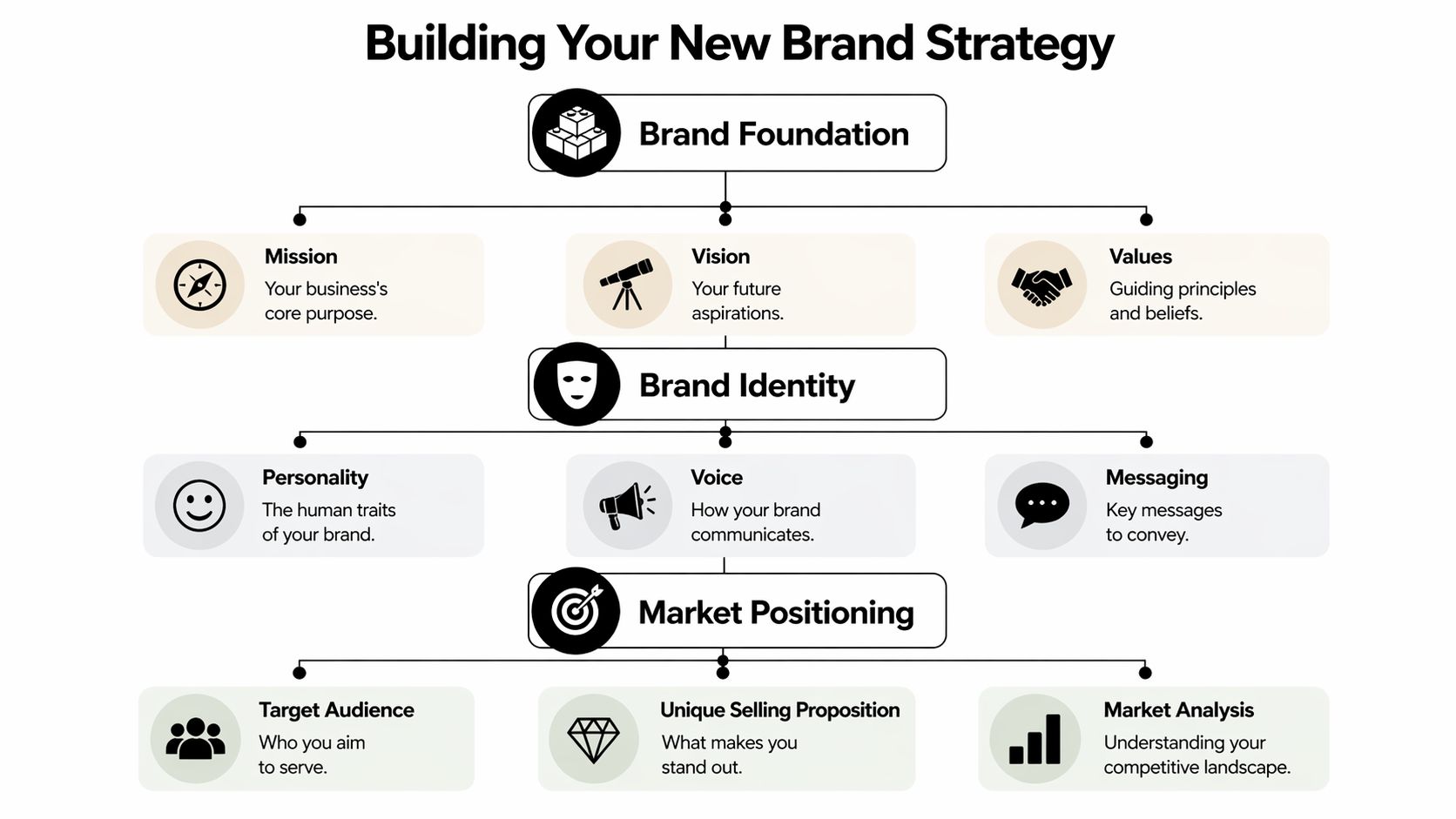
A practical strategy usually starts with three core decisions.
Mission, vision, values
These don't need to sound corporate. They need to be usable.
- Mission: Why the business exists right now. For the bakery, that might be about making high-quality baked goods that feel local, fresh, and dependable.
- Vision: What the business is becoming. Perhaps becoming a recognised Dorset food brand with retail and online reach.
- Values: The standards that guide decisions. Freshness, craft, clarity, friendliness, reliability, provenance.
If you can't picture these affecting hiring, customer service, website copy, packaging, and pricing, they're too vague.
Audience definition
Small businesses often describe their audience too broadly. “Everyone local” isn't a target audience. It's a postcode.
For a useful audience definition, write down:
| Question | Weak answer | Better answer |
|---|---|---|
| Who buys from us | Anyone | Locals buying quality baked goods and hospitality buyers needing reliable supply |
| Why do they choose us | Good products | They want quality that feels local, easy ordering, and confidence for repeat purchase |
| What do they worry about | Not sure | Inconsistent quality, unclear ordering, generic products, poor service |
| What matters to them | Value | Trust, freshness, convenience, taste, and presentation |
That sort of clarity prevents one of the most common rebrand mistakes. Building a brand around how the owner sees the business instead of how customers choose it.
Market position
Positioning is the space you want to own in the buyer's mind. It isn't a slogan.
A useful positioning statement should answer:
- What category are we in
- Who are we for
- What do we do better or differently
- Why should people believe us
For the bakery, the answer might be: a premium but approachable Dorset bakery for customers who want handcrafted quality without the fuss of a luxury-only brand. That's a far clearer position than “traditional with a modern twist”, which sounds nice and says almost nothing.
If your positioning could also fit five competitors in Dorchester, Weymouth, or Bournemouth, it isn't specific enough yet.
Turn strategy into language people will recognise
Once your position is clear, shape the brand personality and tone of voice.
Brand personality is how the business would come across if it were a person. Tone of voice is how that personality sounds in real communication. Many small businesses blend into the same generic voice because they default to bland “professional” language.
For a Dorset business, the strongest voices are often the clearest ones. Direct. Warm. Competent. Not over-written. Not stuffed with marketing filler.
Try making a short table like this for your own team:
| Brand voice choice | What it means in practice |
|---|---|
| Warm | Friendly, but not over-familiar |
| Clear | Short sentences, little jargon |
| Skilled | Show expertise without sounding arrogant |
| Local | Reference place and context naturally, not as a gimmick |
Then test it against real copy. Homepage headline. Enquiry email. Instagram caption. Packaging note. Quote document. If the voice doesn't survive contact with real-world use, rewrite it.
Test before you commit
The strategic phase shouldn't happen in a vacuum. Share early thinking with trusted customers, staff, and a small sample of your real audience. Ask what feels credible, what feels confusing, and what no longer sounds like you.
That kind of testing doesn't need to be complicated. It just needs to be honest. A handful of direct conversations will usually tell you more than a room full of internal opinions.
When small business owners ask how to rebrand a small business without wasting budget, this is the answer I keep coming back to. Decide what the business is becoming, who it's for, and how it should be understood before you touch the visuals.
Creating Your New Visual And Verbal Identity
The visual identity is where most owners want to start. It's also where many projects drift into preference-led feedback and circular decisions.
A strong identity doesn't begin with “make it pop”. It begins with strategy translated into design rules people can use. That means the logo, colour palette, typography, image style, iconography, and written messaging all need to point in the same direction.
What a visual identity needs to do
A logo isn't the brand. It's one part of the recognition system.
For small businesses, the better test is this: does the identity work across the places you use it? Shop signage in Weymouth. A mobile website header. An invoice PDF. Social graphics. Van livery. Product labels. A favicon. A pull-up banner. If it only looks good on a presentation slide, it isn't ready.
The same applies to colours and fonts. They shouldn't be chosen because they're fashionable. They should support the position you've defined. A premium local food brand may need warmth and craft. A law firm may need restraint and clarity. A fitness brand may want boldness and movement. Different strategy, different design language.
Give better feedback and get better work
One of the quickest ways to weaken a rebrand is to turn every review round into a committee taste test.
UK-specific benchmarks note that gaining internal buy-in is a challenge in 26% of rebrands, and successful projects allocate around 36% of the budget to creative alignment so the identity has strategic depth rather than becoming superficial, according to UK rebranding benchmarks discussed here.
That figure reflects a real-world truth. Alignment takes work.
A useful design brief should cover:
- Business context: What changed and why the rebrand is happening
- Audience: Who the brand needs to attract now
- Positioning: What space you want to occupy
- Practical applications: Website, signs, packaging, brochures, uniforms, social templates
- Non-negotiables: Elements that must remain or constraints that matter
- Avoidances: Competitor similarities, overused styles, and tired tropes
If you're looking at external support, graphic design services are one route for turning that brief into a workable system, but the quality of the brief still shapes the quality of the result.
Useful feedback sounds like this: “This feels too corporate for our customer base” or “the typography doesn't match the approachable tone”.
“I just don't like green” is rarely useful.
Build verbal identity at the same time
The visual side usually gets more attention, but verbal identity is what customers read, hear, and repeat.
That includes:
- homepage headlines
- service descriptions
- product naming
- boilerplate company descriptions
- social bios
- enquiry confirmations
- proposal language
- packaging copy
A business can have a beautifully redesigned logo and still sound generic. That's common when the copy remains full of stock phrases like “trusted solutions”, “customized excellence”, or “quality service at competitive prices”. Those lines could belong to almost anyone.
For a local example, think about a community-facing brand such as Crossfit Durnovaria. What gives that type of identity energy isn't only the visual system. It's the language. Short, confident, motivating, recognisable. The words help build belonging.
A short explainer can help when reviewing identity ideas:
The identity checklist I use before sign-off
Before approving a new identity, check it against the following.
Recognition
Can customers still connect the new look to the business they already know?Usability
Does it work in print, online, on mobile, and in small formats?Consistency
Are the colours, fonts, graphics, and image style defined clearly enough for other people to use them correctly?Messaging fit
Does the voice match the visual tone, or do they feel like two different brands?Longevity
Will this still look credible in a few years, or is it chasing a current design fad?
The best visual identities don't shout the loudest. They make the business easier to recognise, easier to trust, and easier to choose.
Updating Your Digital Presence Website SEO And eCommerce
At this point, rebrands either hold together or start leaking value.
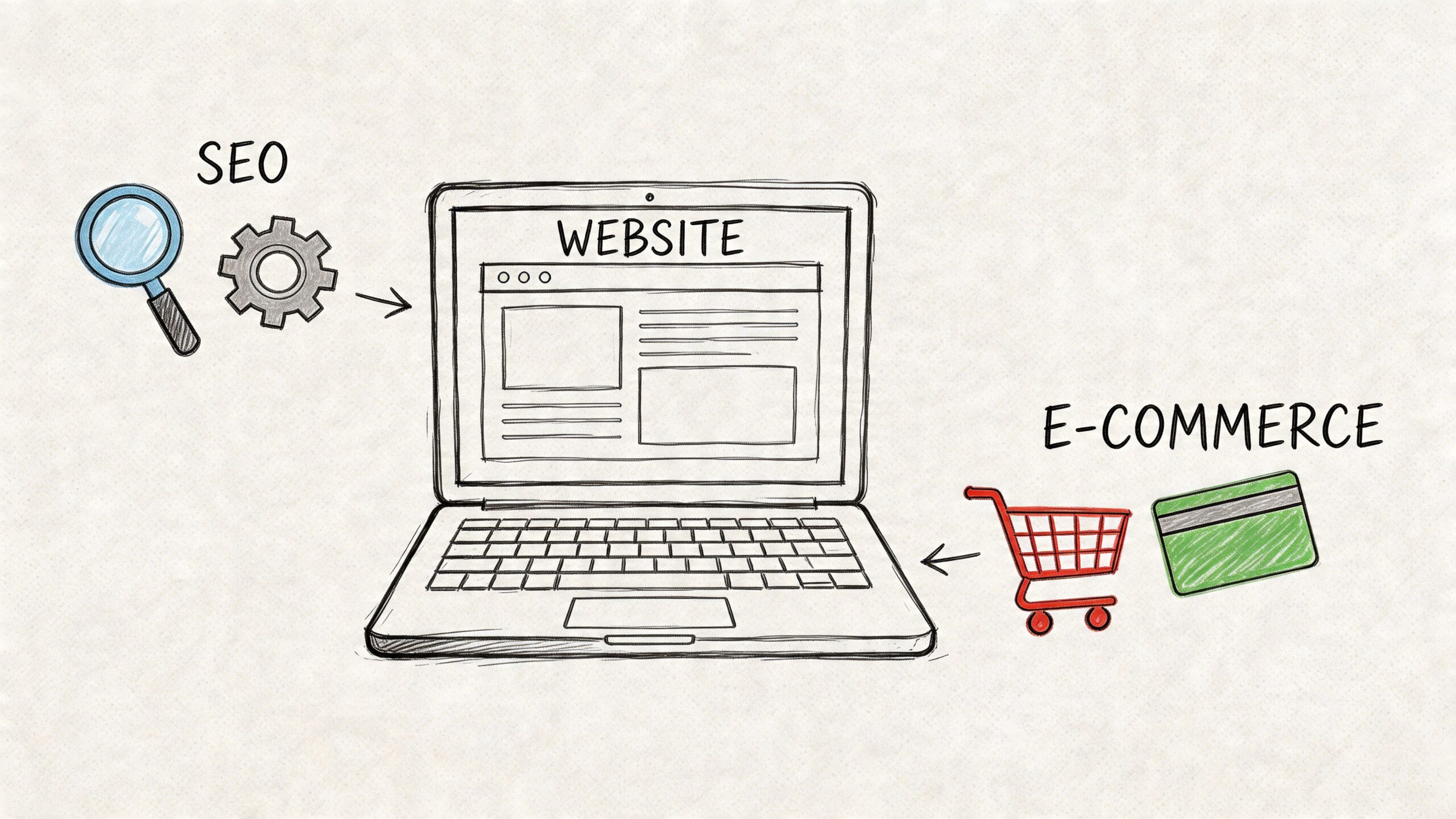
A small business can approve a strong identity, announce it confidently, and still damage visibility by mishandling the website migration, local listings, product pages, redirects, or on-site messaging. In practice, the website is usually the operational centre of the rebrand. It carries the brand, the lead generation, the search equity, and often the sales process too.
For UK businesses that depend on local visibility, this part needs care. Rebranding can cause a 40 to 60% traffic drop if it's not managed correctly, and 15% of Dorset SMEs saw revenue dips in 2025 due to unaddressed NAP inconsistencies across directories post-rebrand, as noted in this guide on Google Business Profile and local SEO.
Treat the website as a migration, not a facelift
If your business runs on WordPress, Shopify, WooCommerce, or a custom setup, a rebrand isn't just a matter of swapping logos and colours. You're changing signals that search engines and customers use to recognise the business.
That means reviewing:
- page titles and meta descriptions
- heading structure
- brand references across page copy
- image alt text
- internal links
- contact details
- footer information
- schema where relevant
- downloadable documents
- checkout and transactional emails
- account pages and customer notifications
A proper migration plan reduces confusion for both users and search engines.
The practical checklist that protects search visibility
Use this before launch, not after rankings wobble.
Core website tasks
- Map old URLs to new ones: If page paths change, redirect old URLs properly so users and search engines land in the right place.
- Update brand references site-wide: Company name, service language, logos, and taglines should be consistent across every template.
- Review high-value pages first: Homepage, key service pages, location pages, top blog content, and product category pages should be checked manually.
- Refresh metadata carefully: New brand, same intent. Don't rewrite titles so aggressively that you lose relevance for established searches.
- Check forms and automations: Enquiry forms, quote requests, newsletter signups, and abandoned basket emails often still carry old branding after launch.
eCommerce-specific tasks
- Product page consistency: Update brand language, packaging imagery, product descriptions, and delivery messaging so the site doesn't feel half old, half new.
- Category structure review: A rebrand often exposes messy navigation. Fix the structure while you're in there if customers are struggling to browse.
- Checkout trust signals: Payment messaging, returns information, customer service details, and FAQs must all match the new brand identity.
- Merchant feeds and marketplace listings: If you sell through multiple channels, update the brand consistently across each one.
For online shops, branding and conversion work are closely tied. If you're reviewing the commercial side of the site during a rebrand, this guide on how to improve ecommerce conversion rates is a useful companion because it focuses on the buying journey, not just design.
Local SEO is where many Dorset firms get caught out
This is the bit owners underestimate.
If you're a local business, your Google Business Profile, citations, and NAP consistency often drive calls, visits, and map visibility. Rebranding touches all three. Change the name on the website but forget Yell, Apple maps, local directories, or your profile details, and you send mixed signals everywhere.
Use a simple local rollout list:
| Area | What to update |
|---|---|
| Google Business Profile | Business name, description, website link, categories, images, services |
| Website contact details | Name, address, phone, opening hours, map embeds |
| Directory listings | Yell and other relevant local or industry directories |
| Social profiles | Display name, bios, website links, imagery |
| Review platform profiles | Brand presentation and contact details |
| Email signatures | Staff signatures, disclaimers, contact links |
A local SEO migration isn't glamorous work, but it's the difference between a clean transition and weeks of avoidable confusion.
If you're changing domain names as part of the rebrand, the stakes rise. Plan the move, preserve page equity where possible, and keep brand naming consistent during the handover. The businesses that run into trouble usually update the front-end appearance first and leave the operational details for later.
Don't ignore the user journey while you're busy changing the brand
A rebrand is one of the best opportunities to fix clunky journeys.
That includes:
- reducing homepage clutter
- clarifying service pages
- improving mobile navigation
- tightening product filtering
- making contact routes obvious
- removing duplicate or outdated content
- bringing design consistency to every touchpoint
Visual branding meets commercial performance. A cleaner identity should also make the site easier to use.
For broader thinking on the online store side, tips for running a successful online store are useful alongside the rebrand work because they focus on practical trading issues, not just aesthetics.
Technical discipline keeps the rebrand credible
The businesses that handle this well don't launch a “new brand” with an old favicon, broken redirects, inconsistent product imagery, and a Google profile that still shows the previous name. Customers notice that stuff. Search engines do too.
If you want your new identity to feel established from day one, the digital rollout has to be treated as an implementation project. Not an afterthought.
Launching Your Rebrand And Communicating Change
A rebrand shouldn't arrive as a surprise to the people who matter most.
The launch phase is where many small businesses lose control of the narrative. They update the website overnight, switch the social profile image, post “big news”, and assume everyone will understand what changed and why. Customers usually don't. They just notice that something looks different and wonder whether the business they trusted is still the same one.
A good launch answers three questions quickly. What changed. Why it changed. What stays the same.
Start internally before you go public
If your staff sound uncertain, the market will feel it immediately.
That includes anyone customer-facing, from office staff to sales reps to people answering calls at the counter. They need a short, plain-English explanation of the rebrand, what language to use, what not to say, and what customers are most likely to ask.
A practical internal launch pack should include:
- The reason for the change: One clear paragraph with no marketing jargon
- The customer message: A short explanation staff can repeat confidently
- Visual reference points: New logo, colours, templates, and approved assets
- Operational updates: New email signatures, proposals, uniforms, signage, and documents
- FAQ responses: Ready answers for “Have you been taken over?”, “Is the company name changing?”, and “Do you still offer the same services?”
Customers take their cue from your team. If the team treats the rebrand as clear and intentional, customers usually do too.
Use a phased communication plan
For small businesses, phased communication is usually more effective than a one-day reveal.
A practical sequence looks like this:
Pre-launch notice
Tell existing customers and key contacts that an update is coming. This is especially important if the business name, website address, packaging, or email domain will change.Launch day message
Publish the new identity across the website, social channels, email, and customer communications at the same time. Keep the message simple. Say what changed and tie it back to the business's growth, clarity, or direction.Follow-up explanation
In the days after launch, show the new brand in context. Before-and-after posts, founder notes, updated signage, team photos, packaging changes, or website improvements help make the shift feel tangible.Local visibility
If you attend events, trade shows, or community exhibitions, carry the brand through physical materials as well. If you need ideas for planning display assets, these exhibition stand design tools are a helpful reference because they show how branded environments need the same clarity as digital ones.
Compliance isn't optional during a rebrand
This is the part many small businesses forget until late in the process.
If your rebrand includes a new website, revised forms, changed tracking tools, updated customer databases, or shifts in how personal data is collected and presented, you need to review the compliance side alongside the design rollout. UK ICO data shows that over 1,200 small businesses were fined a collective £2.5m in 2025 for non-compliant rebrands involving new sites without proper data protection assessments, and a 2026 British Chambers of Commerce survey found 68% of Dorset SMEs reported rebrand delays due to GDPR mismatches, according to this UK rebrand compliance article.
That means checking:
- privacy policy wording
- cookie consent setup
- data collection forms
- mailing list permissions
- analytics and tracking disclosures
- accessibility statements where relevant
- customer data handling during any website or platform migration
A polished launch with sloppy compliance work is still a poor rollout.
Keep the message grounded
The best launch messaging isn't dramatic. It's reassuring.
Customers don't need a manifesto unless your business has undergone a major change. In most cases, they want confidence that the service, standards, and people they trust are still in place, and that the new brand reflects where the business is headed.
That tone matters in Dorset and across the UK generally. Small business customers tend to respond well to clear, confident communication. They respond badly to overblown marketing language that makes a simple business update feel theatrical.
Measuring Success And Avoiding Common Pitfalls
A rebrand isn't finished when the website goes live. It's finished when the business can see whether the change is helping.
Start with a small set of practical measures. Track branded search visibility, website engagement on key pages, lead quality, conversion behaviour, customer feedback, and whether staff are using the new brand consistently. For local businesses, watch Google Business Profile performance, enquiry patterns, and whether customers seem more or less clear about what you offer.
A good post-launch review should ask two things. Did perception improve, and did operations stay stable?
The final checklist
Before and after launch, keep this list close:
- Don't rebrand for cosmetic reasons alone: A weak strategy will produce expensive decoration.
- Don't skip customer input: If the new brand doesn't match customer expectations, adoption gets harder.
- Don't under-scope implementation: Websites, directories, signage, proposals, packaging, and emails all need updating.
- Don't let too many opinions drive the identity: Broad input helps. Design by committee usually doesn't.
- Don't neglect local SEO and profile consistency: Especially if your business relies on maps and local discovery.
- Don't separate compliance from rollout: Privacy, consent, and data handling must be checked as part of the project.
- Don't chase trends: The goal is a brand that feels right for the business, not just current.
A rebrand works best when it makes the business easier to understand, easier to trust, and easier to buy from.
If you're weighing up a rebrand and want a clear view of what needs changing, what can stay, and how to roll it out without creating avoidable problems, DesignStack works with Dorset and UK businesses on branding, WordPress websites, eCommerce builds, graphic design, and the practical implementation that sits behind a successful launch.

Leave a Reply