

UK Graphic Design Agency: How to Hire The Right Partner
Your logo feels tired. Your website still technically works, but it no longer reflects the standard of your business. You know prospects are judging you before they call, enquire, or buy, and you also know that hiring the wrong creative partner can waste months.
That’s where most businesses get stuck.
They don’t struggle because there are too few options. They struggle because there are too many, and most agencies present themselves in almost exactly the same way. Every site says “creative”, “strategic”, and “results-driven”. Very few explain how they work, what trade-offs they make, and whether they’re the right fit for a growing business that needs clear advice, tidy process, and dependable delivery.
Your Search for a UK Graphic Design Agency Begins Here
The search usually starts with a problem that has been building for a while. A business owner notices their brochure no longer matches the website. Their website no longer matches the quality of the service. Their social graphics look like they came from three different companies. Nothing is disastrous on its own, but together it creates friction.
A good uk graphic design agency helps remove that friction. It gives your business a clearer face, a stronger digital presence, and a more consistent way to show up across sales, marketing, and customer touchpoints.
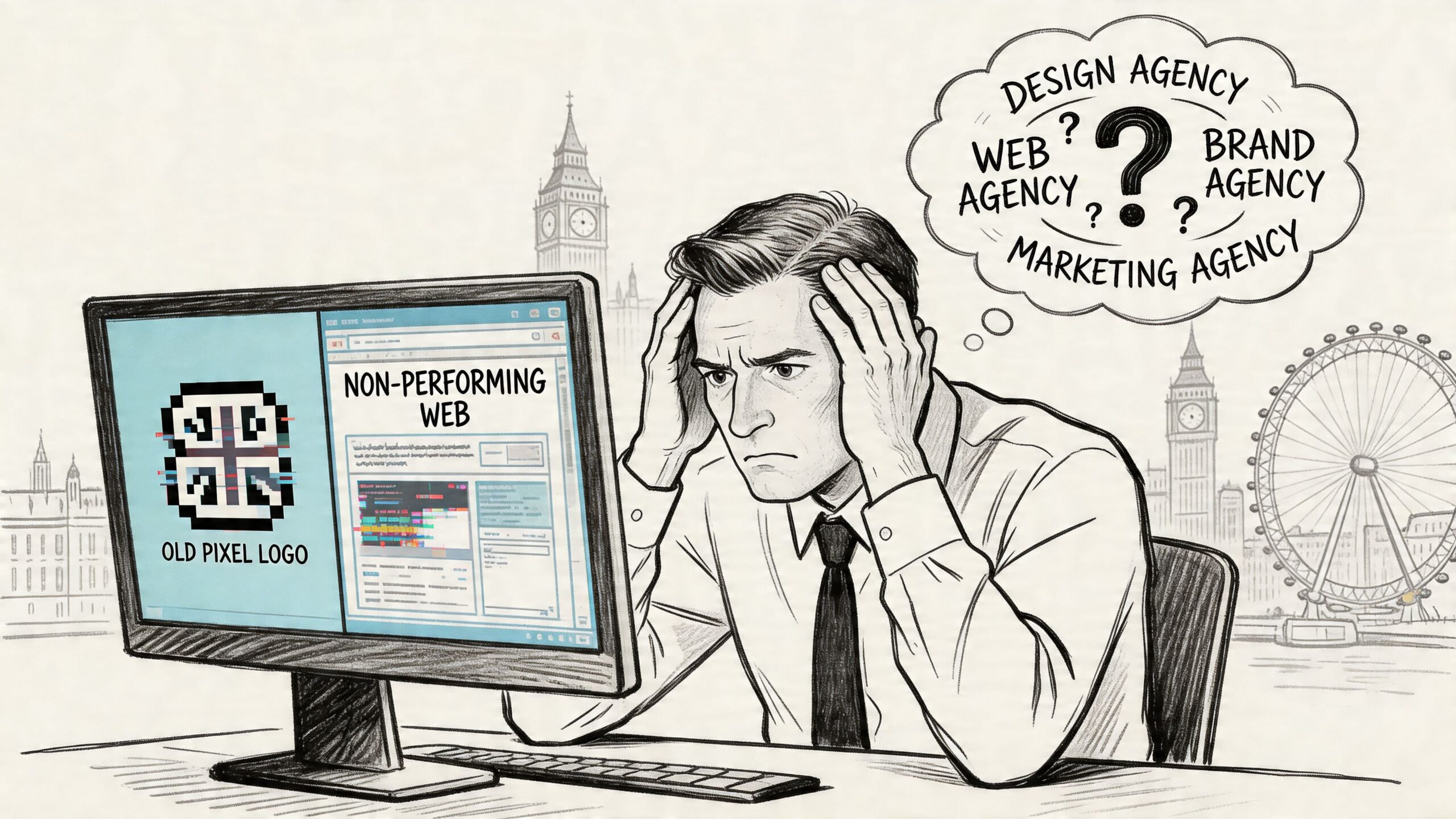
The market is large enough that choice alone won’t help you. The UK graphic design industry comprises 10,943 businesses as of 2026, with a market size of £4.2 billion, according to IBISWorld’s UK graphic design business data. That tells you two things at once. First, demand is real. Second, selecting carefully matters because many agencies can produce attractive work, but fewer can act like a useful business partner.
What most clients actually need
In practice, most businesses aren’t just buying design files. They’re trying to solve one or more of these problems:
- A credibility problem. The business has grown, but the brand hasn’t caught up.
- A consistency problem. Sales decks, website pages, signage, ads, and packaging all feel disconnected.
- A conversion problem. The website looks acceptable but doesn’t guide people clearly enough.
- A capacity problem. Internal teams don’t have time or specialist design skill.
- A decision problem. Too many stakeholders are involved, and nobody has translated business goals into a proper brief.
Practical rule: Don’t hire an agency because you need “design”. Hire one because you need a business problem turned into something customers can understand and trust.
What a strong hiring decision looks like
The right agency won’t just ask what colours you like. It will ask who you’re trying to reach, what your offer is, where customers drop off, and how the work needs to function after launch.
That’s the difference between buying a service and finding a partner.
If you approach the process that way, the shortlist gets easier. You stop looking for the agency with the flashiest homepage and start looking for the one that listens properly, scopes clearly, and can translate your commercial goals into design decisions that hold up in practice.
First Steps Defining Your Design Needs and Goals
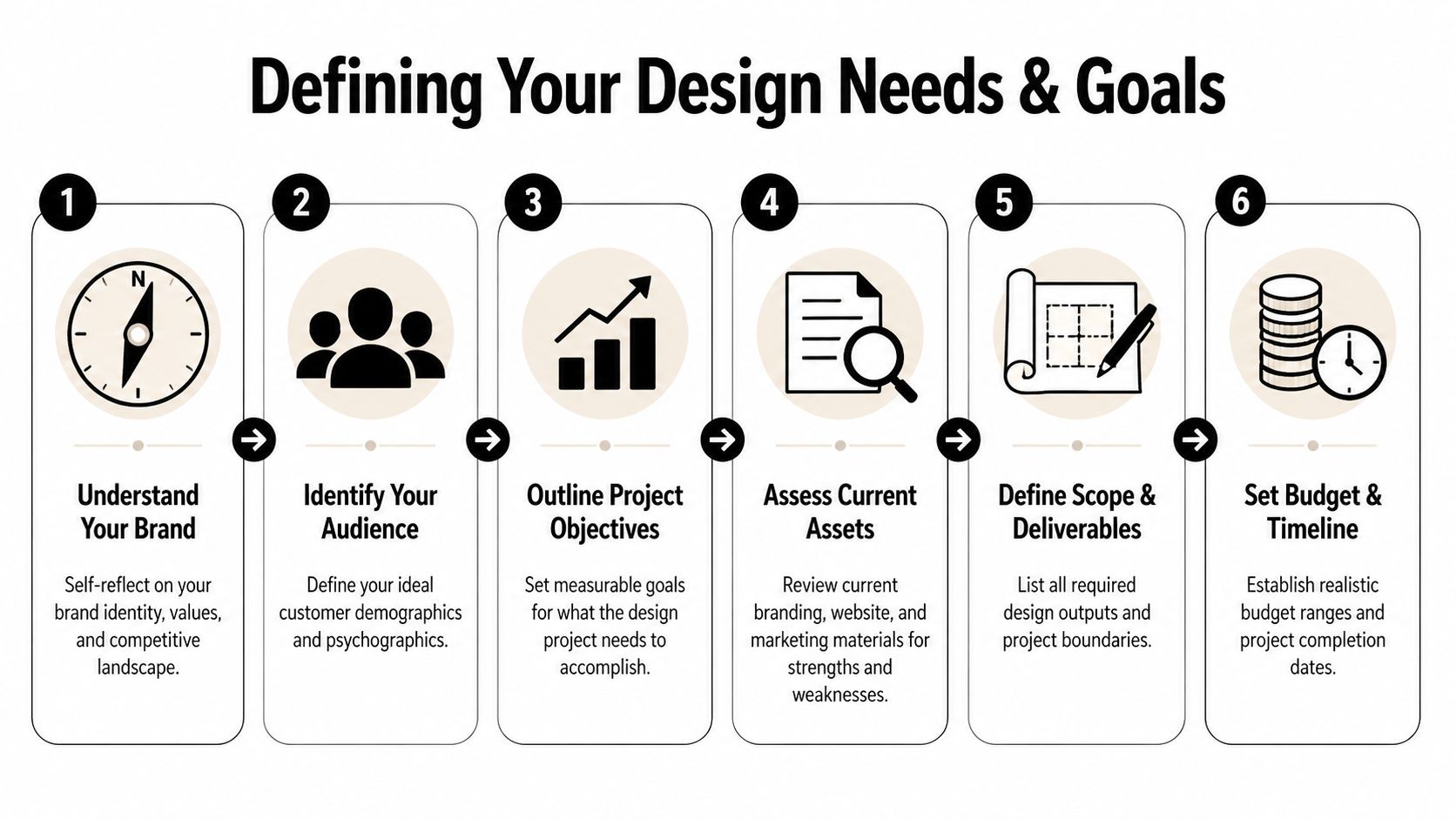
Before you contact anyone, get your own thinking in order. At this stage, projects either gain momentum or become expensive guesswork. Businesses often say they need “a new logo” when the actual issue is broader: poor positioning, weak messaging, an outdated website, or inconsistent brand assets.
If you can define the problem properly, agencies can solve it properly.
The wider market makes this even more important. Graphic design sits inside a £4.2 billion market and supports a broader £46.4 billion UK agency market, with digital services reaching £20.4 billion by 2025. There are also over 2.7 million active UK websites, which is why custom design matters when you need to stand out and convert attention into action, as noted in IBISWorld’s UK graphic design industry overview.
Start with the business outcome
A design brief should begin with what the business needs to achieve, not what software output you want at the end. “We need a brochure” is not the brief. “We need sales material that helps prospects understand our service faster” is closer.
Write down the commercial purpose in plain English. If you can’t explain the reason for the project clearly, the agency will spend half the job trying to uncover it.
Use these prompts:
What has changed in the business
Have you launched a new service, moved upmarket, expanded locations, or outgrown your old identity?
What isn’t working now
Be specific. Is the current website hard to update? Does the branding look dated? Are printed materials inconsistent?
What should improve
Better enquiries, stronger trust, a more premium impression, easier sign-off across your team, or a cleaner customer journey are all valid goals.
Build a brief that an agency can actually price
A vague enquiry produces a vague proposal. Agencies can only scope accurately when you tell them what needs to be delivered and what constraints matter.
A practical brief should cover:
Your business and offer
Explain what you sell, who you sell to, and what makes you different.Your audience
Don’t stop at “small businesses” or “homeowners”. Describe what they care about, what they’re comparing you against, and what reassurance they need before buying.Current assets
List what already exists. Logo files, brand colours, photography, website copy, packaging, brochures, email templates, product imagery, or social assets.Required deliverables
Say whether you need a brand identity, WordPress site, eCommerce build, signage, printed collateral, social templates, or ongoing design support.Practical limits
Include timing, internal approval steps, and any budget boundaries.
A strong brief doesn’t make you look demanding. It makes you easier to work with, and that usually leads to better work.
A quick self-assessment checklist
Use this before you send your first enquiry:
Clarify the trigger
What prompted the project now rather than six months ago?List the must-haves
Separate essentials from nice-to-haves so the agency can prioritise.Review your existing materials
Collect examples of what still works and what no longer represents the business well.Note your decision-makers
Too many reviewers slow projects down. Decide who signs off creative work.Gather examples of style carefully
Reference work you like, but explain why you like it. “Clean layout”, “more premium”, and “easier to read” are more useful than “make it like this”.
If you want a practical framework for shaping that document, this essential website design brief template is a useful starting point. Even if your project includes branding and print as well as web, the structure helps you think more clearly.
What works and what doesn’t
What works is honesty. If your content isn’t written, say so. If your photography is weak, say so. If your team needs guidance, say so. Good agencies can work with those constraints.
What doesn’t work is pretending the project is more defined than it is. That usually leads to rounds of rework, revised quotes, and frustration on both sides.
How to Properly Evaluate Agency Portfolios and Case Studies
Reviewers often assess portfolios too quickly. They look at visual style, decide whether they like it, and move on. That’s understandable, but it’s not enough if you’re hiring an agency to support commercial growth.
A portfolio should answer a harder question. Can this team understand a business problem and turn it into design that works across real channels, with real constraints, for real customers?
Look for the thinking behind the visuals
The first thing to assess is whether the agency shows evidence of problem-solving. A polished logo on a white background tells you very little by itself. A stronger case study explains what the client needed, what challenges existed, what was delivered, and how the work was applied.
When reviewing an agency’s work, ask yourself:
Does the project solve a recognisable problem
Good work usually starts from a business issue, not an aesthetic preference.Can I see the system, not just the hero shot
One homepage mock-up isn’t a brand system. You want to see how identity carries into print, mobile, social, packaging, or signage where relevant.Does the work still feel usable
Some portfolios show dramatic concepts that are hard to maintain in everyday marketing. Useful design survives ordinary business use.
Four filters that separate style from substance
Strategic alignment
The design should fit the audience and business position. A law firm, a local retailer, and a lifestyle brand shouldn’t all be dressed in the same visual language.
If every project in a portfolio has the same mood, same layout treatment, and same typography style, you may be looking at a studio with a signature taste rather than a strategic process. That can work if your needs happen to match their style exactly. It’s risky if they don’t.
Versatility and consistency
A capable agency can carry an idea across multiple formats without losing coherence. That matters because most businesses don’t just need a logo. They need a website, sales PDFs, social graphics, forms, packaging, signage, or ad creative that all belong to the same brand.
A useful test is to scan a project and ask whether the assets feel related without becoming repetitive.
The best portfolios don’t just show design taste. They show design discipline.
Industry relevance
You don’t need an agency that only works in your sector. You do need one that can understand your buying process. A studio that has worked with service businesses, eCommerce brands, membership groups, or hospitality operators may already understand the practical pressures involved.
That said, don’t overvalue sector familiarity if the strategic thinking is weak. An agency can learn your market. It can’t fake a sound process for long.
Evidence of real delivery
Be cautious with portfolios that only show concept visuals or isolated artwork. Ask what was launched. Ask what the client approved. Ask how the work performed in use.
If you want to review an example of how one studio presents delivered work across sectors, browse the DesignStack portfolio. The point isn’t to copy a style. It’s to notice whether the projects demonstrate applied thinking, range, and consistency.
Case study signals that matter more than flash
A useful case study tends to include a few practical details that many buyers overlook:
| What to check | Why it matters |
|---|---|
| Clear business context | Shows the agency understands the client’s commercial reality |
| Scope of deliverables | Helps you judge whether they can handle work similar to yours |
| Application across channels | Proves the brand can function beyond a single mock-up |
| Process visibility | Suggests the team is organised and not improvising |
| Signs of collaboration | Tells you whether they can work with stakeholders, not just present artwork |
What usually goes wrong in portfolio reviews
Clients often make one of two mistakes.
The first is choosing based only on visual taste. That can lead to beautiful work that doesn’t match your audience, budget, or operational needs.
The second is dismissing strong agencies because their portfolio includes sectors outside your own. In reality, a broad portfolio can be a good sign if the work adapts intelligently to different client needs.
Questions worth asking while you review
- Why was this design approach appropriate for that client?
- What parts of this work would still function a year from now?
- Does this agency understand rollout, not just concept?
- Can I imagine handing them a messy brief and getting clarity back?
Those questions will tell you more than “Do I like this colour palette?”
Understanding Agency Pricing and Setting Your Budget
Pricing only feels mysterious when agencies don’t explain what sits behind it. In reality, most uk graphic design agency pricing falls into three models: fixed-cost projects, hourly billing, and monthly retainers. None is automatically right or wrong. The right one depends on how defined your work is and how your business likes to operate.
Regional context matters too. UK graphic design pricing varies significantly by location. London agencies commonly charge £50–£150+ per hour, while freelancers elsewhere in the UK often sit in the £20–£75 range, according to this overview of UK graphic design costs. The same source notes that a simple logo can cost £500–£2,000 nationally, and a full brand package can exceed £10,000. That’s one reason regional agencies can offer stronger value on defined projects without necessarily reducing quality.
The three pricing models clients actually encounter
| Model | Best For | Pros | Cons |
|---|---|---|---|
| Fixed-cost project | Clearly defined branding, websites, brochures, launch work | Budget clarity, easier approval, scoped deliverables | Less flexible if the brief keeps changing |
| Hourly billing | Small tasks, evolving design support, advisory work | Pay for actual time used, useful for undefined work | Harder to predict final cost |
| Monthly retainer | Ongoing design needs across multiple channels | Consistent support, easier planning, better continuity | Works poorly if usage is irregular or priorities are unclear |
When fixed-cost works best
Fixed-cost pricing suits businesses that know what they need and want clarity before committing. It works well for a new website, a brand refresh, a printed sales pack, or a defined launch package.
Clients like it because it removes financial ambiguity. Agencies like it when the scope is sensible and decision-making is organised.
The catch is simple. Fixed-cost only works well when the brief is disciplined. If a project starts as “refresh the website” and gradually becomes “rewrite the content, add eCommerce, redesign the logo, and create a new brochure too”, the relationship gets strained fast.
Why agencies care about utilisation
Behind every quote is a capacity calculation. A UK agency’s profitability is tied to utilisation rate, which is the percentage of staff time that is billable. Junior staff might reach 75%, while directors can drop to 33%, as outlined in Synergist’s guide to agency utilisation rates. That’s why a well-run fixed-cost agency asks detailed scoping questions. It’s not bureaucracy. It’s how they protect quality, deadlines, and margin.
Cheap quotes often hide one of two problems. Either the scope hasn’t been understood, or the agency is relying on speed where your project needs care.
What a sensible budget discussion sounds like
A useful pricing conversation is open and specific. The agency should explain what is included, what isn’t, how revisions work, how feedback is handled, and what would trigger extra cost.
If the quote is materially higher than another one, ask why. Sometimes the difference reflects strategy, content support, senior input, testing, rollout help, or post-launch support. Sometimes it reflects overhead and brand positioning. You need to know which.
A low price can be valid for a simple job. It becomes risky when the project is complex, deadline-sensitive, or tied to business-critical sales activity. That’s why it helps to read a grounded explanation of the hidden costs of cheap website design before comparing quotes solely on headline number.
How to set a budget without guessing
Use this sequence:
Decide what outcome matters most
If the website is your primary sales tool, fund that before secondary materials.Separate launch needs from later phases
Many businesses don’t need everything at once. A phased approach often protects quality.Allow for content and approvals
Delays often come from the client side. Budget time as well as money.Ask for optional extras to be priced separately
This keeps the core proposal clean and avoids confusion.Compare like with like
A cheaper quote may exclude key items such as content population, revisions, training, or support after launch.
The most expensive proposal isn’t always best. The cheapest usually isn’t either. Good value sits where scope, communication, and quality line up with what your business needs.
The Vetting Process Critical Questions and Common Red Flags
Once you have a shortlist, the actual work starts. You then stop being impressed by websites and begin judging how an agency thinks, communicates, and handles uncertainty. The sales process usually tells you a lot about what the delivery process will feel like.
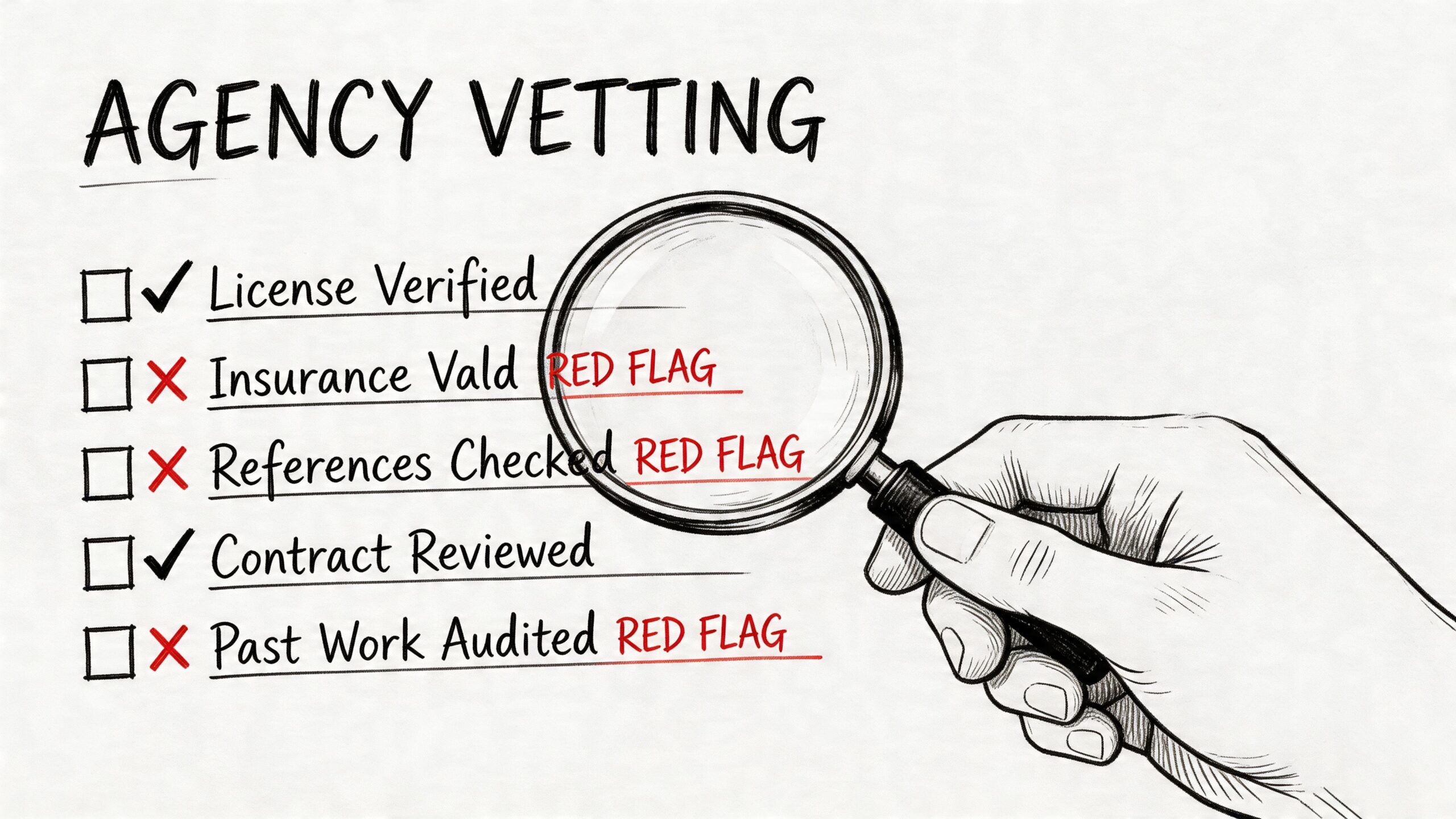
A useful discovery call should feel focused, not theatrical. The agency should ask practical questions, challenge unclear assumptions, and explain its process in a way that makes sense to a non-designer. If you leave a first call with less clarity than you started with, take that seriously.
Questions worth asking on the first call
You don’t need a huge script. You do need questions that reveal whether the agency is organised.
Who will handle the day-to-day work
You want to know whether you’ll deal with a senior designer, an account manager, or a rotating team.How do you run projects from briefing to sign-off
Listen for a clear sequence. Discovery, concepts, revisions, build, testing, launch, handover. If they can’t explain the process clearly, the process may not be strong.How do you handle feedback and revisions
Good agencies have a method for gathering comments, avoiding contradiction, and keeping projects moving.What do you need from us to keep the project on track
This is a strong test. Mature agencies know exactly what client-side delays look like.What happens if scope changes mid-project
The answer should be calm and specific, not vague or defensive.How do you approach fixed-cost work
Scoping discipline matters. A UK agency’s profitability depends on billable time, with utilisation varying by role from 75% for junior staff to 33% for directors, according to the earlier-linked Synergist guidance. In practice, that means careful agencies ask more questions up front because they need to price responsibly.
Agencies that scope properly are usually easier to trust than agencies that promise everything instantly.
Red flags that show up early
Some warning signs appear before a proposal even lands.
Vague pricing language
If you hear “it depends” repeatedly without any effort to narrow the range, the quote may become slippery later.Poor communication during sales
Slow replies, missed calls, unclear follow-ups, and inconsistent answers often continue once the project starts.Pressure to decide quickly
Strong agencies don’t need to force urgency unless there’s a genuine scheduling reason.A portfolio that doesn’t match the service claim
If they say they build strategic brands but only show disconnected visuals, ask harder questions.No real curiosity about your business
If the conversation stays on style preferences and never reaches customers, offer, or goals, they may be treating the job as production only.
Watch how they handle disagreement
The best agencies won’t say yes to everything. They’ll explain why a request may weaken the work, create technical problems, or blur the brand. That’s useful. You’re not hiring a pair of hands. You’re hiring judgement.
A short explainer can help you frame your own evaluation criteria before those conversations get underway:
Good proposals are precise
A strong proposal usually includes scope, stages, timeline, revision structure, assumptions, exclusions, and payment terms. It shouldn’t leave you guessing who writes content, who supplies images, or what support exists after launch.
Here’s a simple way to read one:
| Proposal element | What to look for |
|---|---|
| Scope | Specific deliverables, not broad promises |
| Process | Clear phases and approval points |
| Revisions | Stated limits and method for giving feedback |
| Timeline | Realistic pace with client responsibilities noted |
| Exclusions | Anything not included should be visible |
| Support | Handover, training, or post-launch help explained |
If an agency is messy before the contract is signed, don’t expect it to become organised once money changes hands.
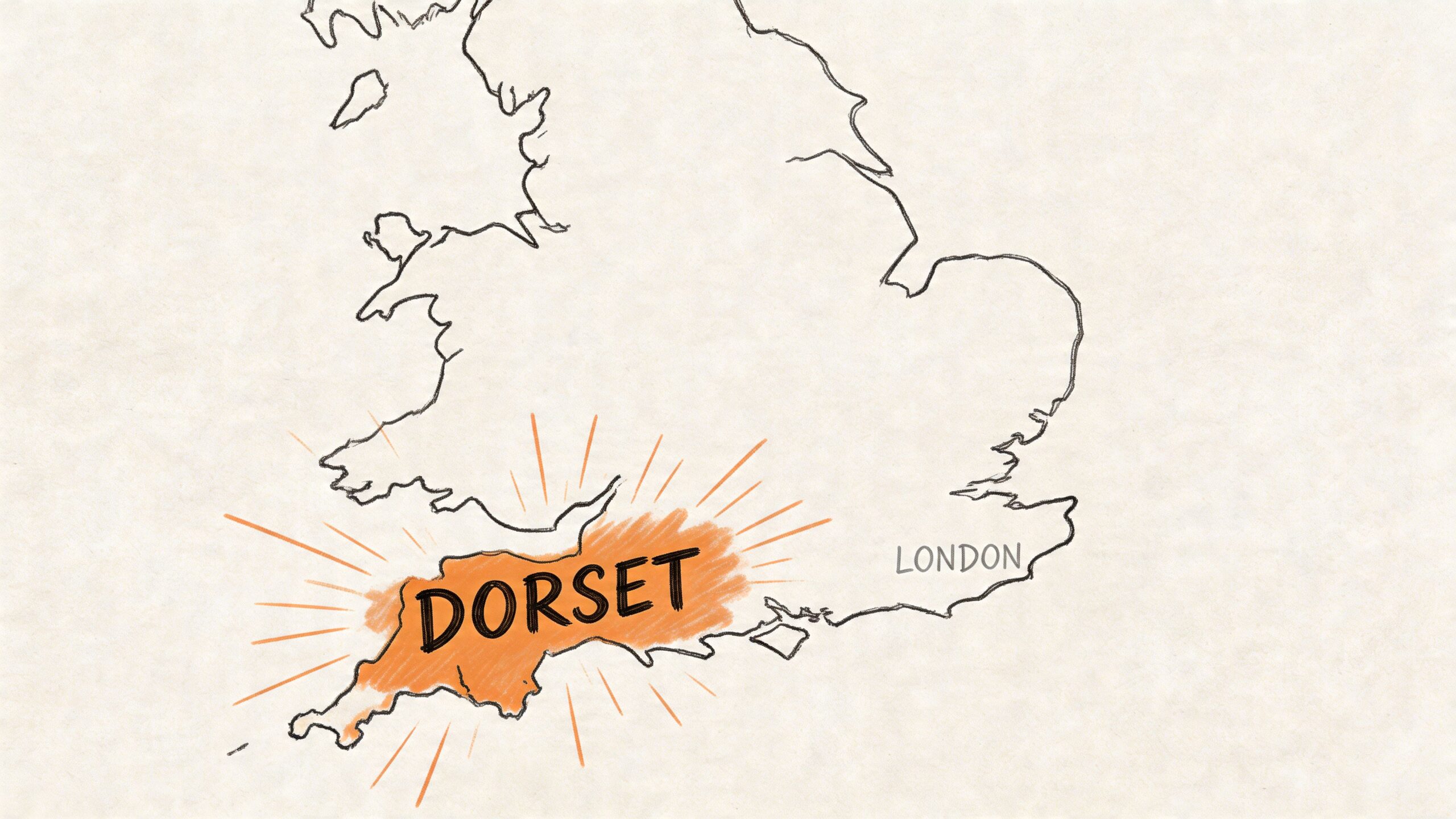
The Local Advantage Why Your Dorset Agency Is a Powerful Asset
There’s still an outdated assumption in UK design that serious work comes from London and that regional studios are somehow a compromise. That assumption doesn’t hold up well anymore.
A persistent London-centric bias still exists in the industry, with many feeling compelled to relocate to the capital for success, even though remote working has reduced the need for a London postcode on national-level projects, as discussed in Creative Review’s look at design beyond London. For clients, that bias can lead to poor decisions. They overlook capable local agencies because they equate geography with quality.
Why regional agencies often work better for SMEs
For many small and medium-sized businesses, a Dorset agency offers practical advantages that matter more than a fashionable postcode.
Closer communication
You’re more likely to speak directly with the people doing the work, rather than being filtered through layers of account handling.Better commercial fit
Regional agencies often understand the pressures local firms face because they work with similar businesses every week.More grounded pricing
Earlier in the article, pricing differences showed why work outside London can represent better value. That matters when your budget needs to stretch across web, branding, and support.Stronger long-term relationship potential
If you need ongoing updates, print work, campaign assets, or technical support later, local access helps.
Local doesn’t mean limited
A Dorset agency can still work nationally. Remote workshops, video calls, collaborative review tools, and cloud-based approvals have made location far less important than responsiveness and clarity.
What changes with a regional partner is often the feel of the working relationship. Discussions tend to be more direct. Turnaround expectations are clearer. Senior input is usually easier to access. For businesses that want a partner rather than a supplier, those things matter.
If your company wants local insight with digital delivery capability, reviewing examples of website design in Dorset can help you assess how a regional studio approaches branding, development, and support in practice.
The hidden strength of proximity
Local knowledge doesn’t just help with map listings or area references. It helps agencies understand context. They know how local organisations present themselves, how regional customers compare providers, and what feels credible in the market.
That doesn’t mean every Dorset business must hire a Dorset agency. It means they shouldn’t dismiss one because it isn’t in London.
There’s a big difference.
Choosing Your Partner for Growth
Hiring a uk graphic design agency isn’t a design purchase in the narrow sense. It’s a business decision about trust, communication, and whether the work will still support you once launch day is over.
The strongest choices usually follow a simple pattern. Define the actual problem first. Review portfolios for thinking, not just style. Understand how pricing works before judging quotes. Vet the agency as carefully as they vet your brief. Then choose the team that communicates clearly and feels capable of guiding the project when decisions get messy.
That same mindset applies in other service categories too. If you’ve ever compared agencies with technical partners, this guide to choosing managed service companies is a useful parallel because it shows how process, accountability, and support often matter more than a polished sales pitch.
A good agency should leave you feeling clearer, not more confused. If you find one that understands your market, challenges weak assumptions, and can translate goals into practical creative work, you won’t just get better design. You’ll get a partner that helps the business move forward.
If you're looking for a partner that can handle branding, web design, graphic design, and ongoing digital support with clear process and fixed-cost delivery, DesignStack is one option to consider.
Leave a Reply