

Brand Identity Course: A Guide for UK Businesses
Your website uses one logo. Your Instagram avatar uses an older one. Your van signage has a different shade of blue. Your invoices sound formal, but your social posts read like a different business entirely. Most small business owners don't set out to create a messy brand. It happens because the business grows faster than the identity around it.
That's usually the moment a brand identity course starts to look appealing. You want clarity. You want your business to look more established. You want to stop second-guessing every design decision or paying for one-off fixes that never add up to a coherent whole.
The harder question is whether a course is the right next move.
For some owners, it is. A good course helps you understand positioning, sharpen your brief, and build enough judgement to manage a rebrand properly. For others, a course becomes a detour. If you're already stretched, need market-ready assets fast, or don't want to become the person making brand decisions in Canva at midnight, hiring a specialist may be the better route.
Why Your Brand Identity Matters More Than Ever
A small business owner usually notices the problem when growth starts exposing inconsistencies. The shopfront looks established, but the website feels generic. The proposal deck sounds polished, while social posts sound like they came from a different company. Prospects may not identify the exact design issue, but they do register the mismatch. That hesitation shows up in weaker trust, slower buying decisions, and more price sensitivity.
Brand identity matters because it reduces that hesitation. It gives customers a clear sense of who you are, what standard to expect, and why your business feels credible. For a UK service firm competing against bigger names, or an ecommerce brand trying to earn repeat purchases, that consistency has direct commercial value. A branding summary from Dash brand statistics reports that many companies associate brand consistency with stronger revenue growth and visibility. The exact percentages matter less than the underlying point. Consistency helps people recognise you faster and trust you sooner.
That is also why a course is not automatically the answer.
If the underlying issue is lack of strategic clarity, learning the fundamentals can help you make better decisions and brief suppliers properly. If the issue is speed, capacity, or execution quality, a course may only delay the rebrand you already need. I often advise owners to separate those two problems early, because learning and delivery are different investments.
Recognition comes from a system people can repeat. It is not one logo file, one nice colour, or one homepage refresh. A usable identity includes typography, colour rules, image direction, messaging, layout logic, and guidance for how those choices show up across proposals, signage, packaging, email, and web pages. If your team, freelancer, or print supplier has to ask you what "looks on brand" every time, the brand is still living in your head instead of in the business.
That creates operational drag.
It also affects digital performance. Website projects often stall because the design debate is really a brand debate. The team is arguing over headlines, hierarchy, tone, and imagery because no one has agreed the brand standards underneath them. That is why brand work and web work need to connect, especially if you are planning a redesign shaped by digital experience design principles.
For founders whose reputation is tied closely to the business, the stakes are even higher. Personal credibility often carries the sale before the company brand fully catches up. This guide on monetizing creator expertise is useful reading if your growth depends on trust, visibility, and authority built around your name. The same commercial logic applies to a company brand. Clear signals make buying easier.
The practical question is simple. Do you need to learn how to define your brand better, or do you need a specialist to build and roll it out properly? A strong identity pays off either way, but the right next step depends on whether your bottleneck is judgement or execution.
What a Brand Identity Course Actually Teaches
A proper brand identity course should feel less like art class and more like building plans for a house. You don't start with curtains. You start with structure.
That's where many buyers get misled. Course pages often sell the exciting parts first: logos, colour palettes, mockups. Those matter, but they come later. The stronger courses teach why the brand exists, who it serves, how it should be perceived, and what visual and verbal decisions support that position.
The four pillars that matter
Think of the curriculum in four parts.
Brand strategy
This is the foundation. You define the audience, the competitive space, the business values, and the positioning you want to own. Adobe's guidance recommends analysing competitors' identities to spot common industry patterns, then defining positioning, personality, and messaging before any visual decisions are made in its brand identity design guide. That sequence matters because strategy gives every later design decision a reason.Visual identity Logos, colour systems, typography, image direction, iconography, and layout principles sit in this area. Good teaching shows how these elements work together, not as separate Pinterest-style choices.
Verbal identity
Many small firms overlook this. A course worth taking should help you define how the brand sounds, what language it avoids, how it writes headlines, and how it adapts tone for sales pages, emails, proposals, and social posts. If you want a practical primer on voice before you commit, Sight AI's article on what brand voice is gives a useful starting point.Brand implementation The identity becomes operational at this stage. You learn how to turn decisions into templates, rules, file structures, and usage guidance that other people can follow.
What weak courses get wrong
Weak courses often reverse the order. They start with mood boards, then jump straight to a logo. That can produce something attractive, but it rarely produces something durable.
A better test is simple. Ask whether the course teaches you to create a brief before you create assets. If the answer is no, expect rework later.
A logo chosen before positioning is usually decoration, not identity.
That matters whether you're learning for your own business or preparing to brief a designer. Without strategic ground beneath it, visual work becomes opinion-driven. One stakeholder wants “modern”. Another wants “premium”. A third wants “friendly but bold”. Nobody agrees because nobody has defined what the brand is trying to do.
For small firms that need practical outputs, the sweet spot is a course that helps you move from research into execution. It should teach you enough to assess a designer's work, build a credible internal brief, or handle selected parts in-house with support from professional graphic design services where needed.
Navigating Course Formats Online In-Person and Bootcamps
There isn't one ideal format for learning brand identity. The best option depends on your time, your confidence level, and what you need at the end of it.
A founder trying to clean up a growing service business usually needs flexibility and direct relevance. An aspiring designer may need structured critique, deadlines, and portfolio pressure. Those are different jobs, so they suit different learning environments.
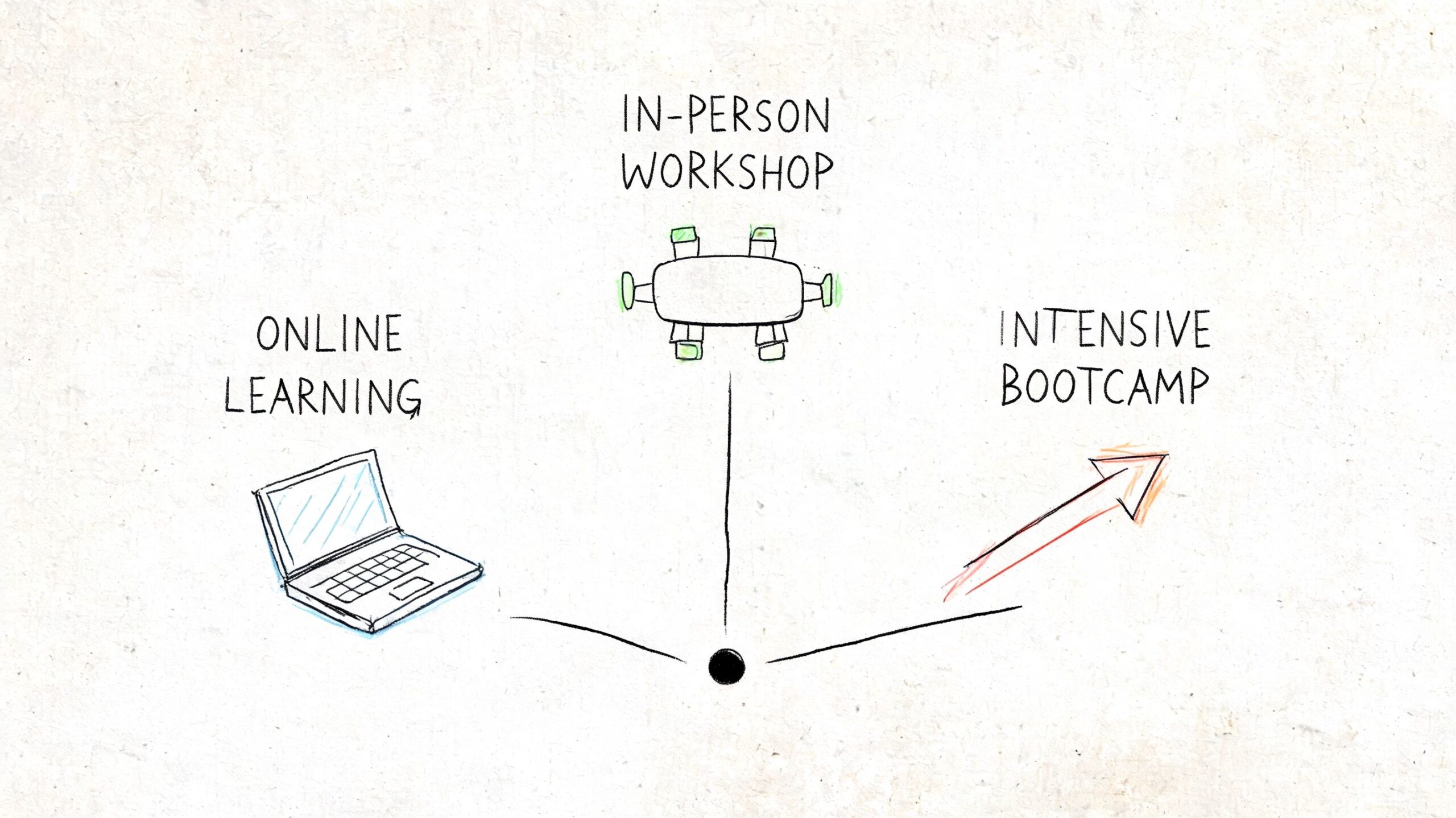
Online courses
Self-paced online learning works well when your calendar is unpredictable. You can pause, revisit modules, and fit the work around running the business.
The trade-off is accountability. Owners often buy a course with good intentions, then only complete the logo module because that feels urgent and visible. If you choose online, look for assignments that force you to write positioning, audit competitors, and document brand rules, not just design assets.
In-person workshops
Workshops can be excellent when you need momentum. Being in the room helps you make decisions faster, ask questions in real time, and get out of your own head.
They're less forgiving if your business day gets derailed. They also tend to compress complex topics into a short window, which is useful for clarity but not always enough for implementation.
In-person teaching is often better for decision-making. Online learning is often better for repetition.
Bootcamps
Bootcamps suit people who want immersion. They're usually the strongest format for aspiring designers because they combine process, critique, presentation skills, and portfolio output in a way shorter courses often don't.
For business owners, bootcamps can be excessive if the actual need is to become a better client rather than a designer. If your goal is to brief, approve, and roll out a rebrand confidently, you may not need an intensive programme built for creative career development.
A simple way to decide
| Format | Best fit | Main advantage | Main drawback |
|---|---|---|---|
| Online | Busy owners and self-directed learners | Flexible pace | Easy to abandon halfway |
| In-person | Owners who need focus and live feedback | Faster decisions | Less flexible schedule |
| Bootcamp | Aspiring designers and career changers | Depth and critique | Bigger time commitment |
Choose the format that matches the role you want to play after the course. That one decision saves a lot of wasted effort.
How to Evaluate and Choose the Right Course
Most course sales pages promise confidence, clarity, and transformation. That doesn't help much when you're trying to separate useful training from polished marketing.
The practical question is this: will the course teach you how to build a brand system that works across real business touchpoints, or will it leave you with a logo on a mockup and very little else?

UCSD's branding course description is a useful benchmark because it highlights logo design alongside the process across digital and print platforms and broader visual systems in its branding and identity design course overview. That's the right standard. Real brands have to work on websites, social headers, packaging, presentations, signage, and printed material. A serious course should reflect that.
Use this shortlist before you buy
Check the teaching order
If the curriculum starts with logo sketches and only mentions audience or positioning in passing, that's a warning sign. Strong courses start upstream.Review student outcomes
Look past polished thumbnails. Can you see strategy documents, naming rationale, guidelines, application mockups, and handover material, or just isolated logos?Look for system thinking
The course should cover brand guidelines, asset variations, and use across multiple channels. If it only teaches a hero logo, the learning is too narrow for most businesses.Assess the instructor's real-world context
A capable teacher should understand client approval loops, conflicting stakeholder opinions, rollout issues, and production constraints. Pure theory isn't enough.Test whether governance is included
Often, courses fall short regarding this aspect. You need rules, not just inspiration.
What quality looks like in practice
A decent course teaches creation. A strong course teaches judgement.
That means helping you answer questions such as these:
- Should this typeface be used in long-form copy or only in headlines?
- Does the icon set still make sense when shrunk for a favicon or social avatar?
- Can the brand survive without photography if budget is tight?
- Will the colour palette hold together across print, web, and packaging?
Here's a useful reference point on what a fuller process can involve:
What works: Courses that force you to make and defend decisions.
What doesn't: Courses that let you stay at the level of taste and mood.
If you're evaluating providers rather than courses alone, compare how they talk about deliverables. Some businesses decide to learn enough to brief well, then outsource production. In that situation, agencies such as DesignStack can handle brand identity and rollout work while the owner stays focused on decision-making and implementation inside the business.
Custom Learning Paths For Business Owners vs Designers
The phrase brand identity course hides two very different needs.
One person wants to rebrand a business without making expensive mistakes. Another wants to become the person who creates brand identity for clients. Those paths overlap, but they shouldn't be confused.
If you're a business owner
You probably don't need to become fluent in every design tool. You need to understand enough to make sound decisions, brief the work clearly, and stop judging creative output based on personal preference alone.
The most useful course content for owners usually includes audience definition, competitor review, positioning, messaging, how to write a brief, and how to evaluate concepts against business goals. If the programme spends most of its time inside software tutorials, it's probably the wrong fit.
Business owners benefit most from learning how to direct a rebrand, not how to produce every file themselves.
If you're an aspiring designer
You need process and output. That includes research methods, identity development, typography systems, logo architecture, presentation structure, guidelines, and client handover. You also need critique. Without critique, it's easy to mistake finished visuals for solved problems.
A stronger designer-focused course also teaches how to explain decisions to clients. Many juniors can make attractive work. Fewer can present it in a way that wins approval and survives implementation.
Which Brand Identity Course Path Is for You
| Focus Area | Best for Business Owners | Best for Aspiring Designers |
|---|---|---|
| Primary goal | Make better brand decisions for your company | Build brand identity as a service or career skill |
| Strategy training | High priority. Especially positioning and audience clarity | High priority. Needed to justify design choices |
| Design software | Helpful but secondary | Important for execution and portfolio work |
| Brief writing | Essential | Useful for discovery and client management |
| Presentation skills | Useful for internal buy-in | Essential for client work |
| Guidelines and rollout | Important for operational use | Important for handover and system design |
| Best outcome | A clearer brief, sharper judgement, better supplier management | A stronger portfolio and repeatable process |
A common mistake on both sides
Owners often buy a designer's course and get bogged down in craft detail they'll never use. Designers sometimes buy founder-focused material and come away with insight but not enough execution practice.
Match the course to your role after the learning ends. If you'll still be running the business day to day, choose decision-making over software depth. If you want paying client work, choose critique, systems, and presentation over general inspiration.
Understanding Course Costs and Calculating Your ROI
Course pricing varies a lot, and that's one reason owners hesitate. The problem is that “cheap” and “good value” aren't the same thing.
A lower-cost course can be useful if it gives you a clearer brief, helps you stop making random design decisions, and prevents a messy rebrand. An expensive course can still be poor value if it teaches broad theory but leaves you without practical rollout tools.
Look at the alternative cost
The right comparison isn't only course versus no course. It's also course versus hiring help, delaying the decision, or repeatedly paying for disconnected assets.
If your current brand confusion keeps causing rework on your website, print, packaging, or social content, the hidden cost is time and inconsistency. Teams end up re-approving the same basics over and over because no shared standard exists.
A simple ROI test for owners
Use these questions before spending anything:
Will this help me make faster decisions?
If yes, that has operational value.Will it improve the quality of the brief I give freelancers or agencies?
Better briefing usually means fewer revisions and less wasted spend.Will I apply the learning within the next few months?
Timing matters. A good course bought at the wrong moment often becomes shelfware.Do I want knowledge, deliverables, or both?
If you need a live brand system soon, learning alone may not be enough.
When a course is the better investment
A course often makes sense when the business is still clarifying its offer, the owner wants to be closely involved, or budget needs to be protected while strategy is developed internally.
It makes less sense when speed matters more than learning, stakeholders are already misaligned, or the business lacks internal capacity to carry the work through. In those cases, paying for specialist execution can be the more efficient choice.
The return usually comes from avoiding poor decisions, reducing rework, and creating a brand your team can use consistently. That's harder to see on a spreadsheet than a line item for design, but it often matters more over time.
Your Next Steps A Small Business Action Plan
A small business owner usually reaches this point after the same pattern repeats a few times. The website looks one way, sales decks look another, social posts feel generic, and nobody is fully sure what the brand should sound or look like anymore. That is the moment to stop shopping for courses and decide what problem needs solving first.
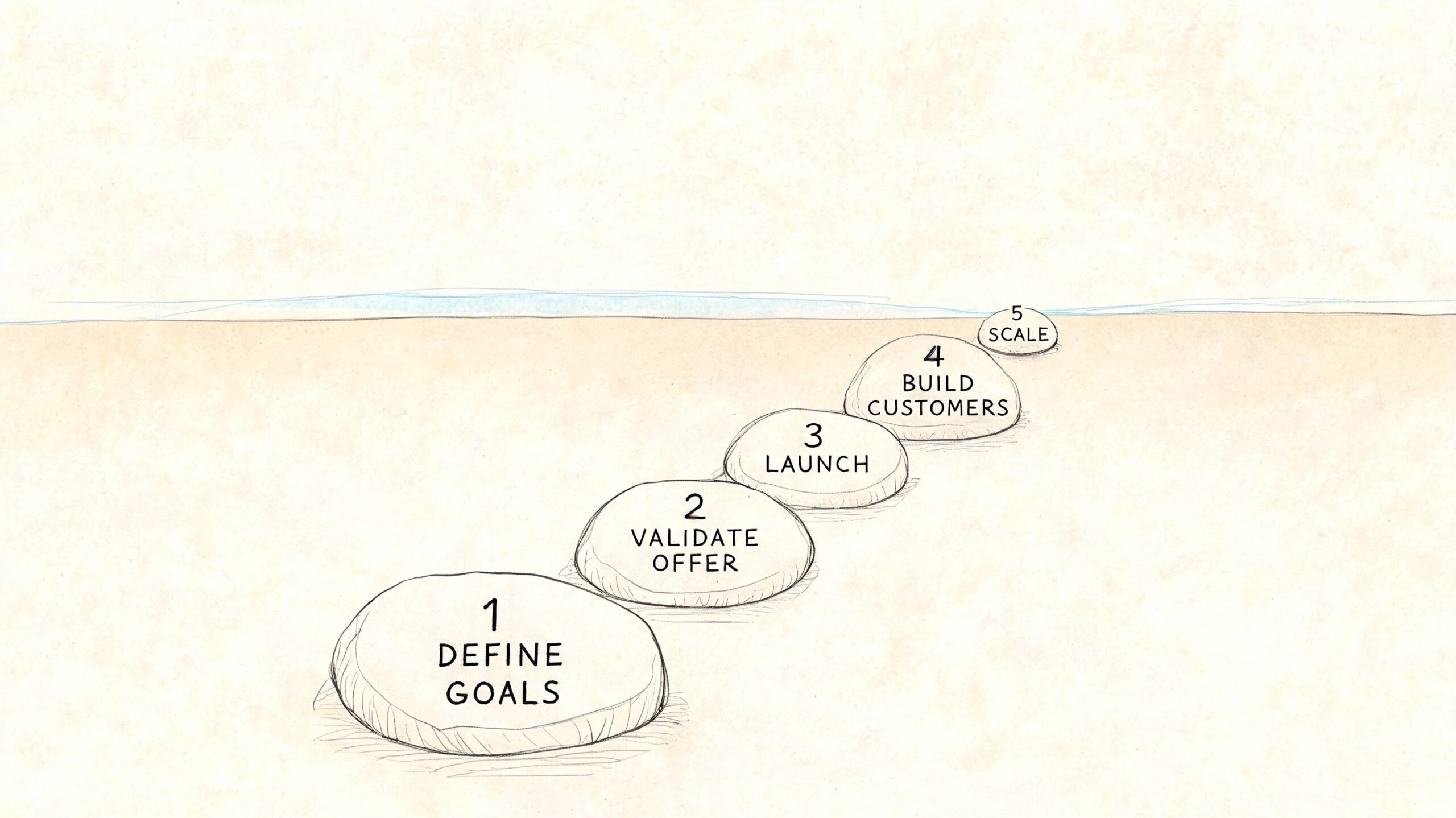
A five-step decision list
Audit how the brand shows up today
Gather your website, social profiles, proposals, signage, packaging, email templates, and printed material in one place. Look for inconsistency in logo use, colours, type, imagery, and tone of voice. The goal is to see whether you have a design problem, a messaging problem, or a wider business positioning problem.Name the commercial goal
"We need a rebrand" is too vague to guide a good decision. Pin down what success would change in practice. You may want to attract higher-value clients, support a price increase, launch a new service, bring several channels into line, or replace a DIY identity that now makes the business look smaller than it is.Choose the role you want to play
Many owners waste money here. If you want to understand the process, sharpen your judgement, and brief suppliers better, a brand identity course can be a sensible investment. If you need a finished identity system in market quickly, learning may slow you down. In that case, agency or freelance support is often the better route.Check what must work in practice
Good branding is not only about visual taste. It has to be usable, legally sensible, and practical to apply across the business. The guidance referenced by 4 The Creatives on branding notes the importance of trade mark checks before committing to an identity, reflecting the UKIPO point that this is a practical step businesses shouldn't miss. A strong name or visual direction is only useful if you can use it and protect it.Plan rollout before any redesign begins
Decide what gets updated first and who owns each part. For many small businesses, the website, core sales materials, email signatures, and social profiles come before lower-priority items. Sequencing matters because a half-launched rebrand often creates more confusion than the old identity did.
DIY, guided learning, or hire help
For business owners, the right next step depends on capacity as much as ambition. A course makes sense when you want to stay close to the strategy, have time to apply what you learn, and are still working out how the business should be positioned. It is less useful when the decision has already been made and the primary need is execution.
Aspiring designers should judge courses differently. They need feedback, portfolio-quality projects, and process depth they can use with clients. Owners need enough knowledge to make better decisions, protect budget, and avoid approving weak work. Those are different learning paths, and treating them as the same usually leads to disappointment.
If you already know the brand needs professional rollout across web and supporting materials, hire for that outcome directly. This guide to finding a website designer who understands your vision is a useful starting point for assessing fit, process, and capability.
The best next step is the one that reduces confusion, speeds up decisions, and gives the business a brand system people can use.
If your brand has outgrown its current look and you need a clearer route forward, DesignStack works with businesses on branding, graphic design, and website projects that need practical rollout across digital and print. Whether you choose to learn first or want help implementing a rebrand, the identity has to work in day-to-day operations, not only on a presentation slide.

Leave a Reply