

Abandoned Cart Recovery Playbook for UK eCommerce Stores
74% of UK baskets created in the final quarter of 2024 didn't become completed orders, according to Novuna's UK checkout abandonment study. On mobile, the situation was worse, with 76% of orders left incomplete, compared with 67% on desktop, according to Statista's UK device data.
Those figures make one point clear. Abandoned cart recovery isn't mainly an email copy exercise. It's a checkout, delivery, returns, trust, timing, and measurement problem. A recovery sequence can reclaim valuable sales, but it'll perform far better when the original checkout promise gives shoppers a clear reason to continue.
Table of Contents
- Why Abandoned Cart Recovery Is a Revenue Lever for UK Retailers
- Fixing Checkout Friction Before You Send Recovery Messages
- Building a Timed Multi-Channel Recovery Sequence
- Segmenting Abandoners and Using Incentives Without Eroding Margin
- Measuring Recovery Performance and Running Profitable A/B Tests
- Implementation Checklist and Common Pitfalls to Avoid
Why Abandoned Cart Recovery Is a Revenue Lever for UK Retailers
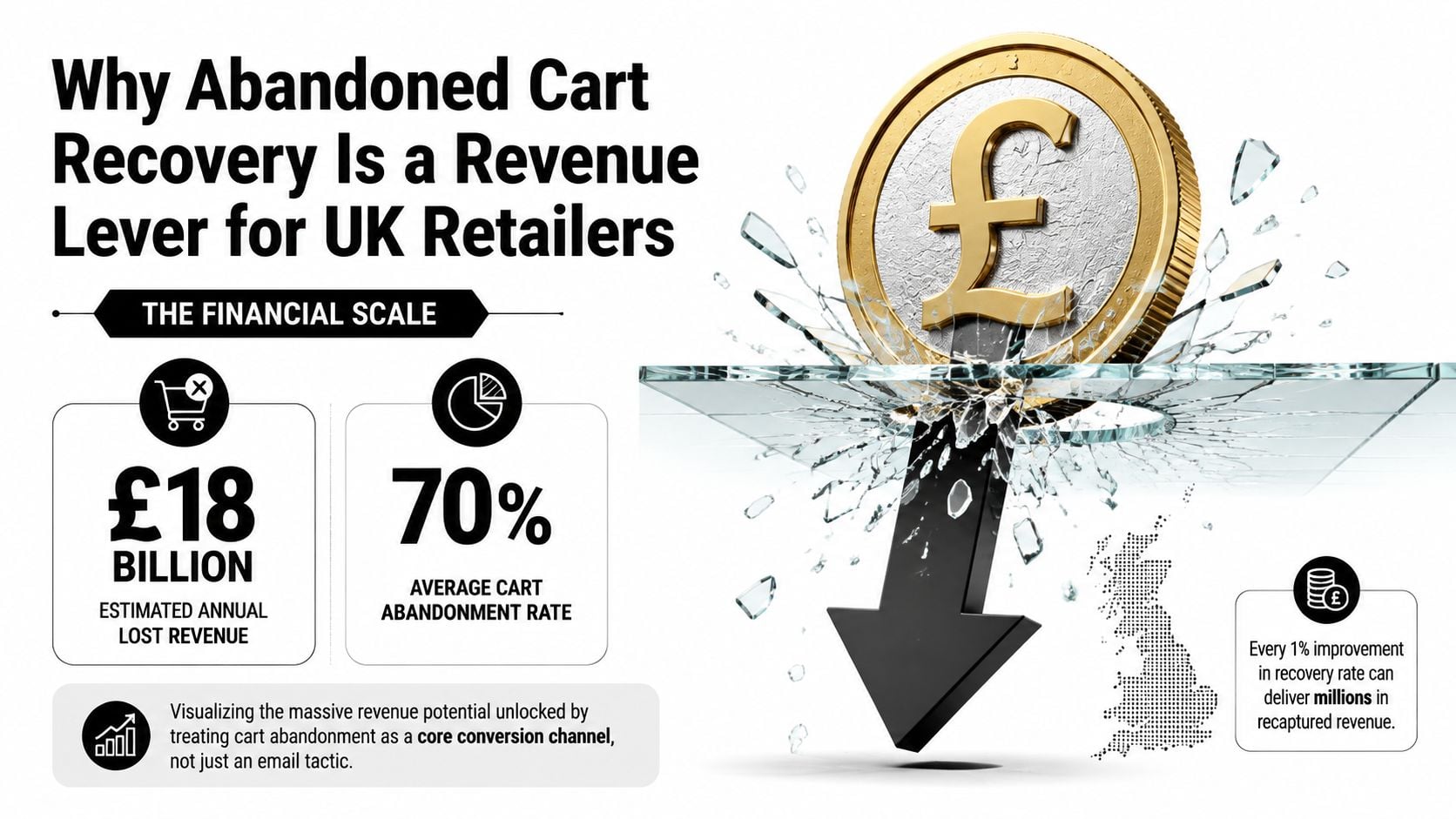
UK retailers reportedly lost £38 billion to online cart abandonment in 2024, an 11% year-on-year increase, according to Novuna's research. For smaller WooCommerce stores, that figure represents more than a market-wide warning. It points to existing demand that the retailer has already paid to attract, but has not yet converted.
A basket signals stronger intent than a casual visit. The shopper may be comparing prices, checking delivery dates, questioning the returns process, or getting distracted. Those reasons require different responses. A reminder can help a distracted shopper, while clearer delivery or returns information may be needed when the checkout promise creates doubt.
Recovery became measurable
Retailers have moved from treating abandonment as a broad ecommerce health metric to examining what happens after a shopper leaves. A 2016 Optilead survey reported that 81% of online cart abandonment was totally ignored, based on 2,838 abandonment tests. It also recorded an average response time of 6 hours and 54 minutes, with £1.7 million of abandoned transactions left untouched from a total real-world test value of £2.1 million.
The practical lesson is clear. Track how many shoppers abandon, whether the store follows up, how quickly each message arrives, which channel it uses, and whether the resulting order is incremental. A recovered order that would have happened anyway should not be treated as campaign revenue.
Fresh Relevance analysis cited by Novuna placed UK cart recovery at around 5% during 2023, meaning fewer than 1 in 20 abandoned baskets were recovered through follow-up activity. A separate UK and EU recovery guide from SaleCycle puts typical recovery at 3% to 5%, while stronger multi-channel programmes can reach 10% to 14%.
Commercial reality: A recovery plugin that sends one generic email is only the starting point. It cannot compensate for unclear delivery costs, weak returns information, or a checkout that is difficult to complete on mobile.
Why SMEs should prioritise it
For a smaller WooCommerce retailer, recovery activity uses traffic already acquired, product pages already built, and stock already held. It can also expose problems that standard conversion reporting hides, such as shoppers leaving when delivery costs appear or abandoning only on smaller screens.
The strongest approach combines prevention with follow-up. First, make the checkout promise credible by showing delivery, returns, payment, and mobile usability information at the point of decision. Then send relevant reminders to shoppers who still leave. Adding more messages without fixing the underlying experience creates more baskets to recover and can train customers to wait for discounts.
Fixing Checkout Friction Before You Send Recovery Messages
80% of British shoppers abandon when their preferred delivery option is missing, while 75% leave when the returns process fails to meet expectations, according to DHL's 2025 ecommerce trends report. Delivery-related problems also contributed to abandonment among 40.6% of UK shoppers in the past year, based on Sendcloud's UK findings. The practical lesson is clear: recovery starts with a checkout promise customers can trust.
Audit the mobile checkout first
Mobile deserves priority. UK abandonment was 76% on mobile compared with 67% on desktop in Q4 2024, according to Statista's UK data. Test the complete journey on a real phone, including product selection, address entry, payment, validation, and confirmation. A desktop browser narrowed to a smaller window will miss touch and keyboard problems.
Check whether shoppers can:
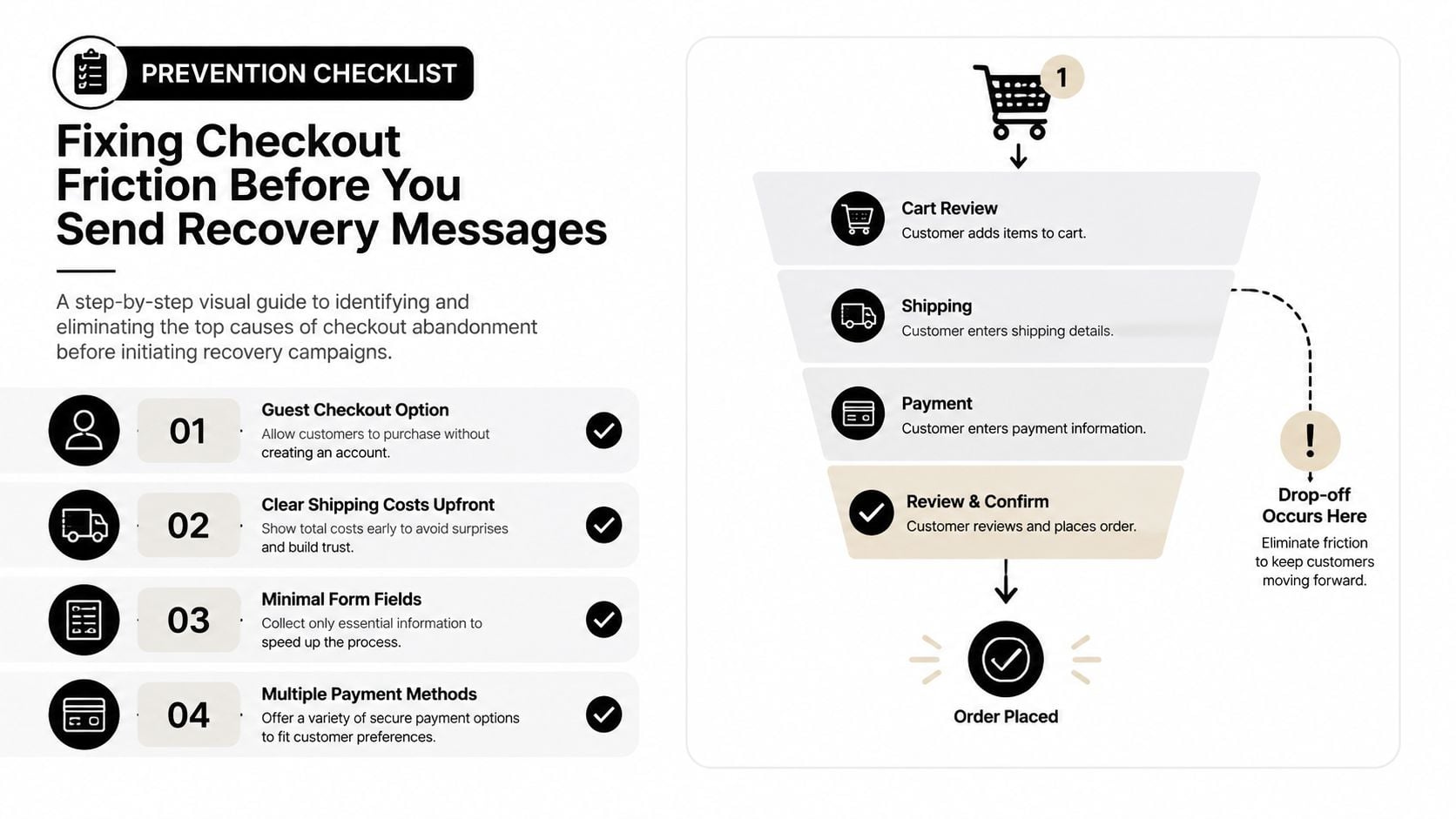
- Continue as guests: Let first-time buyers pay without creating an account.
- Complete short forms: Remove non-essential fields and enable browser autofill where possible.
- Tap without zooming: Payment buttons, quantity controls, address fields, and error messages should remain usable on a small screen.
- Recover from mistakes: Keep entered information after validation fails, then identify the exact field requiring correction.
- Use familiar payment methods: Show the options customers expect instead of making them search for alternatives.
For a broader usability review, connect the checkout audit with this guide to improving website user experience. Focus on hesitation, backtracking, and unnecessary decisions, not just visual polish.
Make the promise visible before payment
Show delivery costs, delivery windows, availability, and collection options before the final payment stage. “Delivery calculated at checkout” creates uncertainty just as the shopper is judging whether the total remains acceptable.
Returns information needs the same treatment. Use plain language, explain the practical process, and make product-specific exclusions obvious. A reassuring recovery email cannot fully offset a policy that feels hidden or difficult to interpret.
Review checkout analytics step by step. A sharp drop after shipping selection points towards delivery options or pricing. Exits after payment errors require a technical fix before new subject lines. Recovery messages should address genuine hesitation, not compensate for a broken path.
A visual walkthrough can help the team assess issues consistently:
Building a Timed Multi-Channel Recovery Sequence
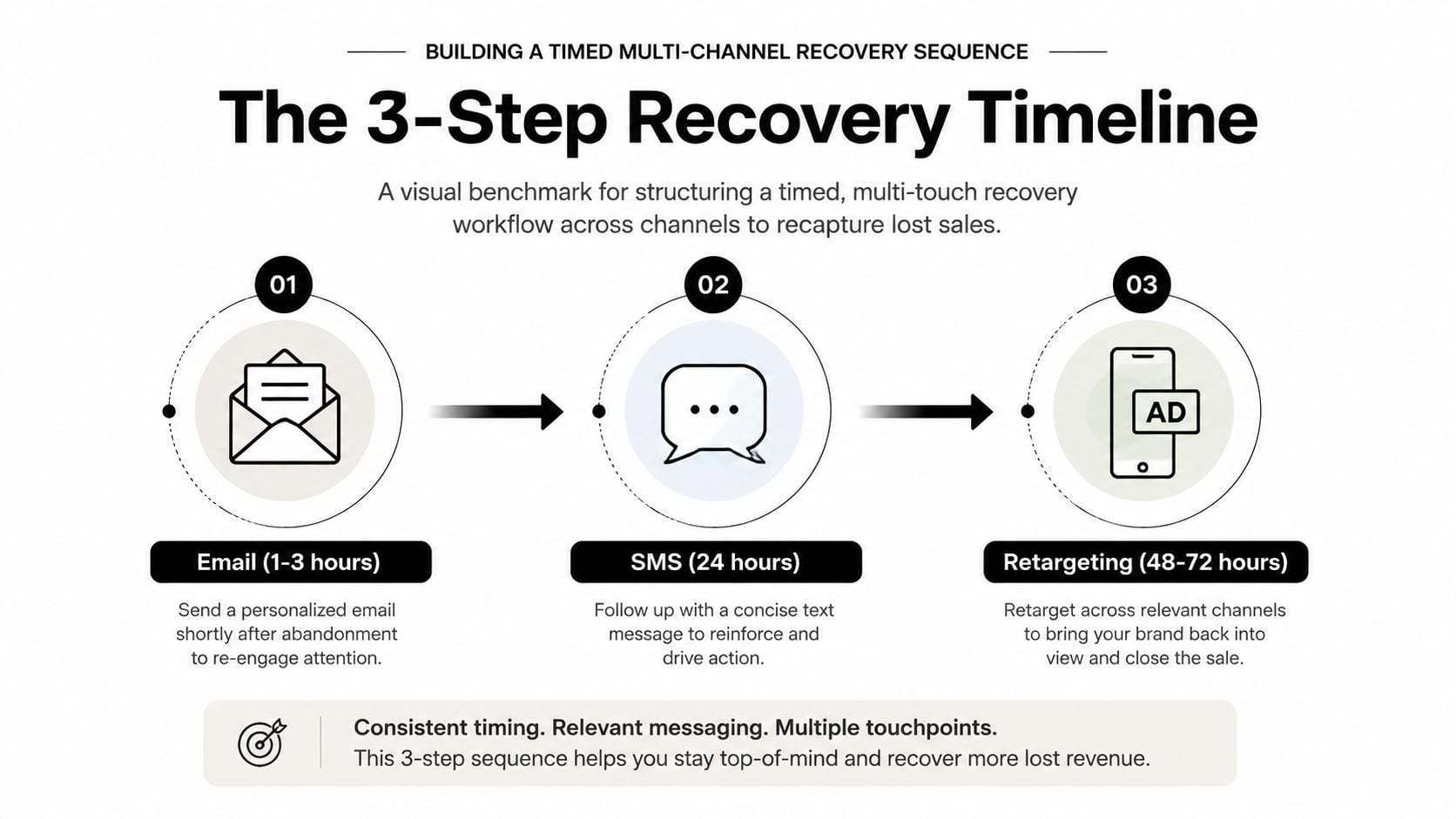
Once the checkout promise is credible, build recovery around clear channel roles and controlled timing. A practical UK and EU sequence uses three messages at approximately 1 hour, 24 hours, and 72 hours, coordinating email, SMS, and retargeting instead of repeating the same prompt across every channel, as outlined in SaleCycle's UK and EU recovery guidance.
First touch, make returning easy
Send the first email soon after abandonment, while the product and checkout context remain familiar. Show the actual items, retain variants such as size or colour, display the current price, and link directly to the basket or checkout. Test that the link restores the correct session on mobile, where a broken or expired basket can waste the recovery opportunity.
Lead with convenience and clarity. If delivery timing, stock status, or returns could explain the exit, answer one relevant concern without filling the message with policy text. The checkout should already carry the main promise. The email should make that promise easy to act on.
The first message has one job: remove the work involved in finding the product again. A generic “you forgot something” reminder makes the shopper reconstruct the journey and gives no fresh reason to continue.
Second touch, add reassurance
At around 24 hours, change the angle rather than repeating the first email. Use relevant reviews, sizing guidance, product details, delivery information, or a concise explanation of returns. Choose the evidence that matches the likely hesitation, so a customer uncertain about fit does not receive a long delivery message.
SMS can support this stage for customers who have provided the required consent. Keep it short, identify the store, show the product or basket context, and provide one clear link. Do not send identical email and SMS copy within minutes. That creates duplication rather than useful personalisation.
Retargeting can support the sequence when the customer has not purchased and advertising consent is in place. Keep the product recognisable across the sites and apps the shopper already uses. Suppress adverts for sold-out items, changed prices, or offers the customer cannot redeem.
Channel rule: Email explains, SMS prompts, and retargeting maintains recognition. Each touch should add something new.
For wider campaign planning and channel coordination, digital marketing support for small businesses can help connect recovery activity with acquisition and retention work.
Final touch, escalate carefully
At approximately 72 hours, choose between a relevant urgency message, an incentive, or a quiet exit. Use real stock constraints or a genuine offer expiry only when they apply. Manufactured urgency damages trust and teaches customers to ignore future messages.
Suppress anyone who purchases as soon as the order is confirmed. Also suppress customers who repeatedly ignore the sequence, especially when further sends add cost without useful engagement. A smaller, targeted audience is healthier than endless reminders to every abandoner.
Record the original cart, message exposure, channel clicks, order status, refunds, and returns. Without these controls, a multi-channel programme can look active while sending conflicting messages and overstating recovered revenue. Review the workflow on mobile as well as desktop, because a persuasive reminder still fails if the return journey does not load or preserve the basket.
Segmenting Abandoners and Using Incentives Without Eroding Margin
Different abandoners face different barriers. A delivery-cost surprise, a broken payment form, a momentary distraction, and a deliberate search for a deal require different responses. Segment the recovery decision around the shopper's behaviour and the most likely reason for leaving.
Useful segments include device type, customer status, basket value, product category, prior purchases, engagement with earlier messages, and the checkout stage reached. Keep the rules clear enough for a trading manager to audit. Complex automation makes it difficult to explain why one shopper received free shipping while another received no incentive.
| Abandoner Segment | Likely Reason | Recommended Incentive | Risk if Misapplied |
|---|---|---|---|
| New visitor with a mobile checkout exit | Friction, uncertainty, or trust concerns | Delivery and returns reassurance, not an immediate discount | You subsidise a customer who needed a clearer checkout |
| Returning customer with a familiar product | Distraction or delayed intent | Direct basket link and concise reminder | Excessive explanation slows a purchase that was nearly ready |
| Shopper who reaches shipping selection | Delivery cost, timing, or missing option | Suitable delivery option or carefully controlled shipping benefit | A percentage discount may fail to solve the actual objection |
| High-value basket with strong engagement | Hesitation over risk or total cost | Later-stage free shipping or margin-approved incentive | A large discount can remove profit from an order likely to convert |
| Repeat abandoner who responds only to offers | Price sensitivity or learned behaviour | Delayed, conditional offer with clear limits | Early incentives teach the customer to wait |
| Cart containing restricted or low-margin products | Commercial constraints | Reassurance, product information, or no incentive | Discounting can turn a sale into an unprofitable order |
The guidance on improving website conversion rate supports this approach because segmentation should follow the point where confidence drops, rather than start with a coupon.
Use incentives as a diagnostic tool
Free shipping can address a delivery-cost objection more directly than a percentage discount. Returns reassurance suits uncertainty about fit or commitment. Some shoppers need no incentive, particularly after a technical error has been corrected or when their previous purchases converted without offers.
Delay any offer until the earlier reminder and reassurance message have had time to work. As noted earlier, the SaleCycle UK and EU recovery guidance warns that early discounting can train customers to abandon deliberately. Later, conditional incentives can support recovery while protecting margin.
Set eligibility rules before launching. Exclude restricted products, low-margin lines, and customers who have already used a relevant offer unless the expected contribution still meets the store's threshold. For high-value baskets, test free shipping against a capped monetary benefit, since the lower-cost option may resolve the objection without reducing the value of every item.
Measure incremental profit rather than coupon usage. If shoppers who receive a discount would have purchased anyway, the campaign has transferred margin instead of creating an additional order. Compare similar audiences with and without the incentive, then review results by segment. That evidence should determine which customers receive an offer, when it appears, and when the store should provide reassurance alone.
Measuring Recovery Performance and Running Profitable A/B Tests
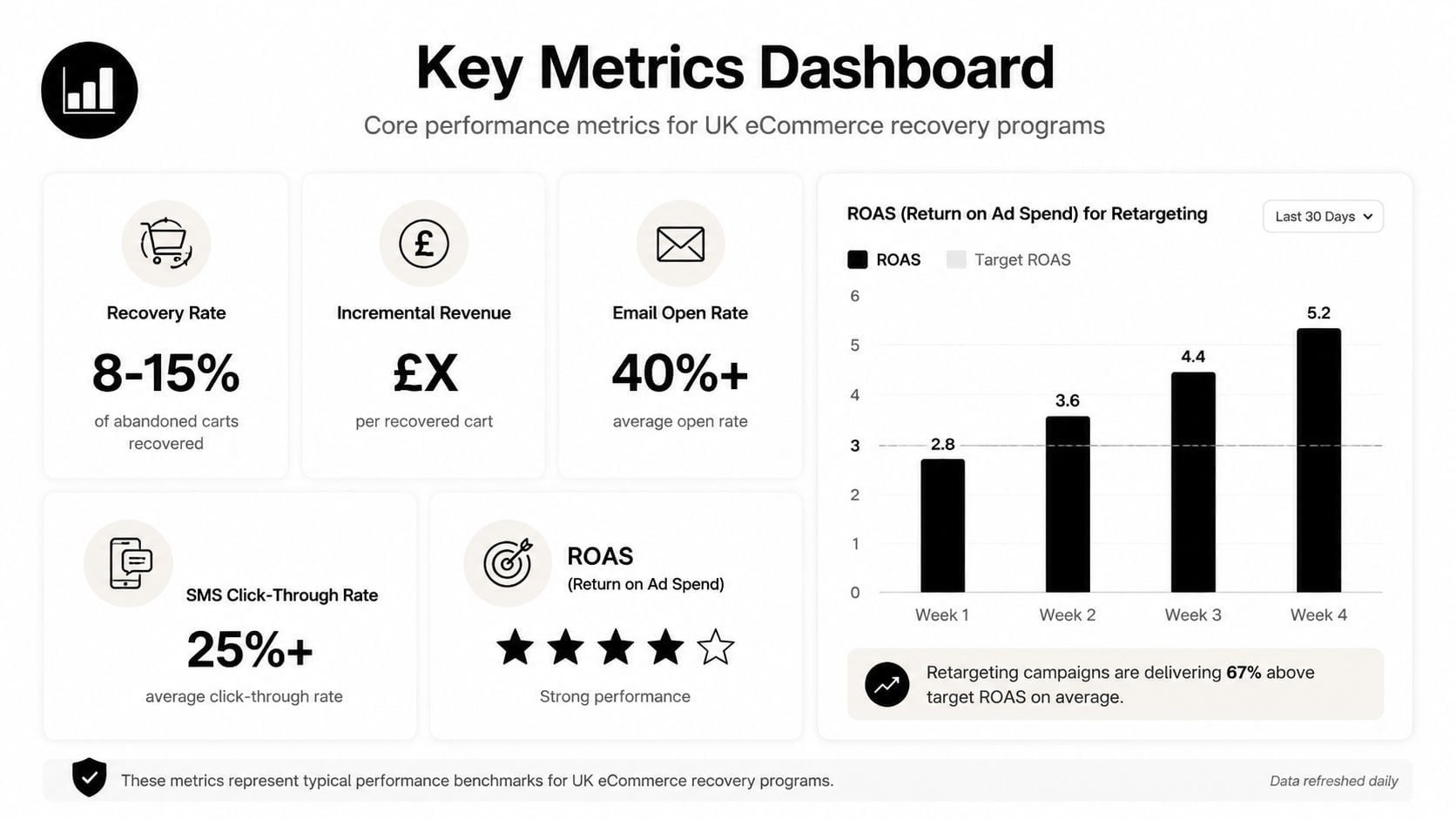
A recovery dashboard should answer a commercial question: did the programme create profitable additional orders, or did it claim credit for sales that were already likely? Recovery rate is one metric among several, and relying on it alone distorts the picture of programme performance.
Track abandoned baskets, recovered orders, recovered revenue, margin after incentives, refunds, returns, unsubscribe activity, and channel results. Break performance down by device, customer type, product category, basket value, and abandonment stage. A blended figure can hide a mobile payment problem or make a low-margin discount campaign appear successful.
Build a useful measurement model
Define recovery rate consistently as recovered carts divided by total abandoned carts. Set the rules before launch. Specify the attribution window, whether a purchase must use the recovery link, and how to classify orders completed later through direct navigation.
Record net value as well. An order that is later refunded should not sit in the same category as a completed, retained sale. Include discount cost, SMS charges, advertising spend, fulfilment implications, and customer service costs when assessing profitability.
For WooCommerce stores, website analytics support can help create a reporting structure that connects checkout behaviour with campaign outcomes instead of isolating email metrics.
Test one meaningful variable
Prioritise tests that can change commercial performance:
- Timing: Compare an earlier first reminder with a later one while holding copy and audience steady.
- Message angle: Test a product reminder against delivery or returns reassurance.
- Incentive logic: Compare no incentive, a shipping benefit, and a controlled discount in separate segments.
- Channel order: Test whether SMS supports email more effectively before or after the second message.
- Checkout destination: Compare a basket link with a direct product link when the customer's original path is known.
Judge tests using completed orders, net revenue, profit, and customer complaints. Opens and clicks provide diagnostic context, not a commercial verdict. An attractive subject line can raise engagement while bringing low-quality visits, and a high click rate can still produce weak margin.
Keep suppression rules active during every test. If one group receives reminders after buying, the results become unreliable and the customer experience suffers. Compare groups with the same checkout promise, delivery information, returns reassurance, and mobile path, otherwise the test may measure friction rather than recovery messaging.
Implementation Checklist and Common Pitfalls to Avoid
Launch abandoned cart recovery in a controlled order. First, test the WooCommerce checkout on mobile, confirm delivery and returns information appears before payment, and verify that guest checkout, payment methods, stock handling, and error messages work as intended.
Then configure the recovery system:
- Capture valid consent: Store email and SMS permissions correctly, and exclude customers who haven't agreed to receive the relevant channel.
- Create the first reminder: Show the exact basket, preserve product choices, and link to a working checkout.
- Add a reassurance touch: Use delivery, returns, product information, or reviews instead of repeating the first message.
- Apply segment rules: Separate new visitors, returning customers, high-value baskets, mobile exits, and shoppers with previous offer engagement.
- Delay incentives: Reserve discounts or shipping benefits for cases where the likely barrier and margin justify them.
- Suppress purchasers: Stop every recovery message after a confirmed order, cancellation, or relevant stock change.
- Check attribution: Report recovered orders alongside refunds, returns, incentive costs, and channel spend.
Common failures are predictable. Retailers send a discount before explaining delivery, use desktop-friendly forms on mobile, fire every channel at once, and keep messaging customers who have already purchased. Others install a plugin but never inspect whether the recovery link works, whether product variants are preserved, or whether the reported revenue is incremental.
Use this website launch checklist when implementing checkout and tracking changes so technical checks don't get lost among campaign tasks. A reliable programme won't recover every basket. It will make the checkout clearer, follow up promptly with relevant help, and show which interventions produce profitable orders.
DesignStack builds conversion-focused WordPress and WooCommerce websites, including practical abandoned basket recovery features, clearer checkout journeys, and analytics support for UK businesses. Visit DesignStack to discuss a checkout audit, ecommerce rebuild, or recovery workflow customised to your store.


Leave a Reply