


Website Design Nuneaton: Grow Your Business in 2026
You've probably had this thought already. Your business is solid, people in Nuneaton know your name, and referrals still come in. But your website either looks dated, says very little, or leaves you wondering whether it does anything useful at all.
That's the problem with most local sites. They exist, but they don't help you make better decisions. They don't show which pages bring enquiries, where people drop off, or whether your calls to action work. Even worse, a lot of agencies still sell “SEO” and “responsive design” like that's enough, while 72% of UK small businesses still lack a functional analytics setup to measure conversion rates after launch according to Core 365's Nuneaton web design page. A website without measurement isn't a business asset. It's a digital brochure with no feedback loop.
If you want better website design in Nuneaton, stop asking whether a site will “look modern”. Ask whether it will track enquiries properly, protect you from avoidable accessibility risk, and give you a clear return over time. That's where true value sits. It also links directly with how your site supports visibility in search, especially when paired with practical local tactics such as local SEO for businesses.
Table of Contents
- Is Your Website Winning Nuneaton Customers?
- What a High-Performing Nuneaton Website Really Needs
- The DesignStack Web Design Process Step by Step
- Our Core Website Services for Your Business
- How Much Does Website Design in Nuneaton Cost?
- Our Work With Businesses Like Yours
- Your Website Design Questions Answered
Is Your Website Winning Nuneaton Customers?
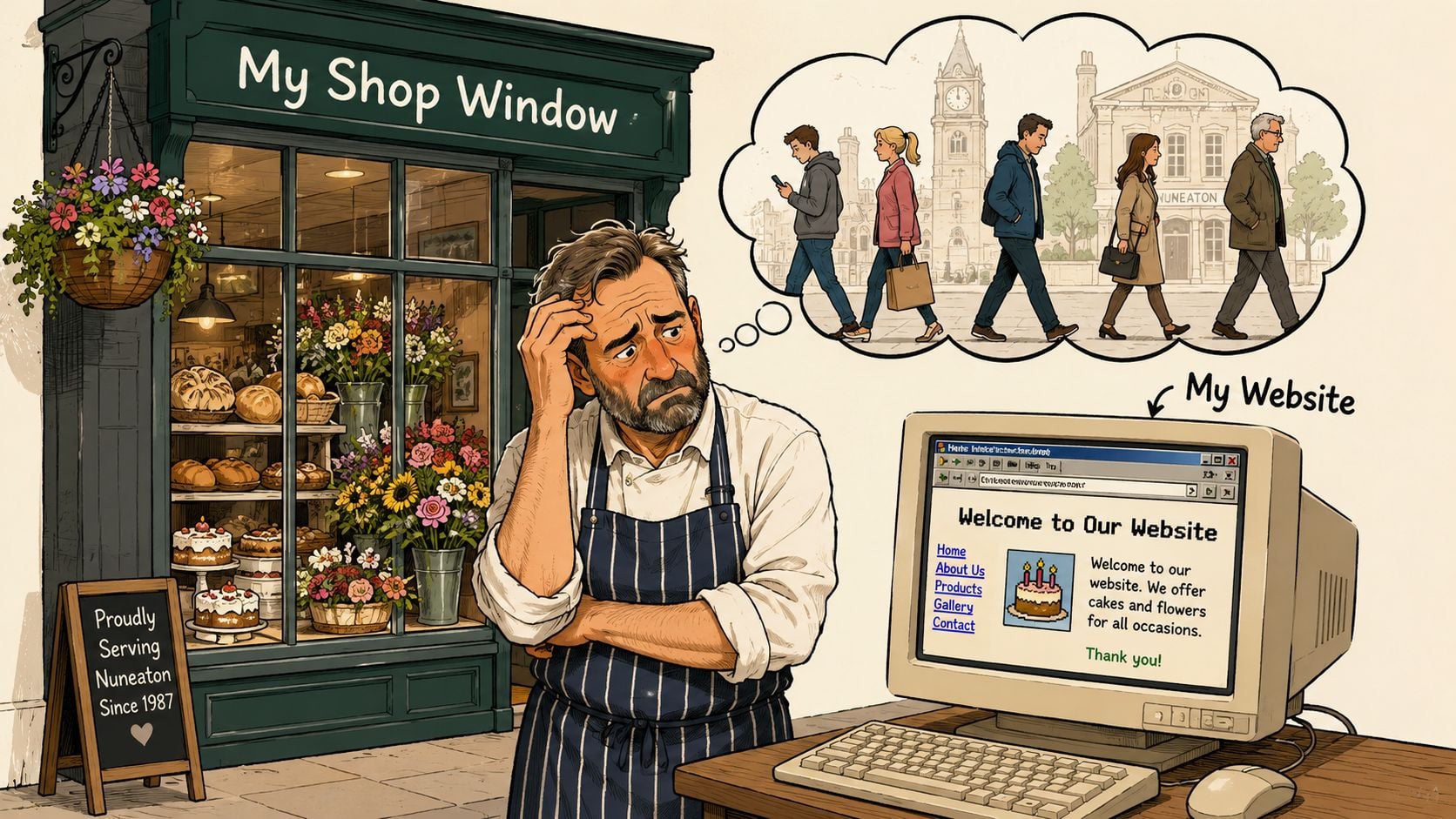
A common story goes like this. A Nuneaton business owner has built a strong reputation over years. Customers trust them, staff know their job, and the service is far better than the competition. Then a potential customer lands on the website and sees an old layout, weak messaging, and a contact form that may or may not be working.
That gap costs you. Not because people are shallow, but because your website is your first test of credibility. If the site feels neglected, visitors assume the business might be too.
A good-looking site can still underperform
Plenty of businesses have already paid for a redesign once. The site may even look clean. The issue is that nobody set it up to answer basic questions.
- Which page brings the most enquiries
- Which service page gets traffic but no calls
- Whether people tap your phone number on mobile
- Whether your contact form submissions are being tracked at all
If your site can't answer those questions, you can't improve it with confidence. You're guessing.
Practical rule: If your website doesn't measure phone clicks, form submissions, and key page visits, it isn't finished.
Why so many websites disappoint
Most website design Nuneaton pages talk about visuals first. They promise a modern build, some SEO basics, maybe a responsive layout. That's fine, but it misses the point. A business website should help you make decisions, not just avoid embarrassment.
The biggest missed piece is functional GA4 setup. Not “analytics installed” in the vague sense. Proper event tracking, clean reporting, and conversion goals that reflect how your business wins work. For a trades firm, that might be quote requests and calls. For a retailer, it could be product views, basket actions, and completed orders. For a service business, it's often enquiry intent, not just traffic.
The question worth asking today
Open your site and test it like a customer. Can you understand what the business does within seconds? Can you book, call, or enquire without friction? Can you measure what happens next?
If the answer is no, your website isn't supporting your reputation. It's dragging behind it.
What a High-Performing Nuneaton Website Really Needs
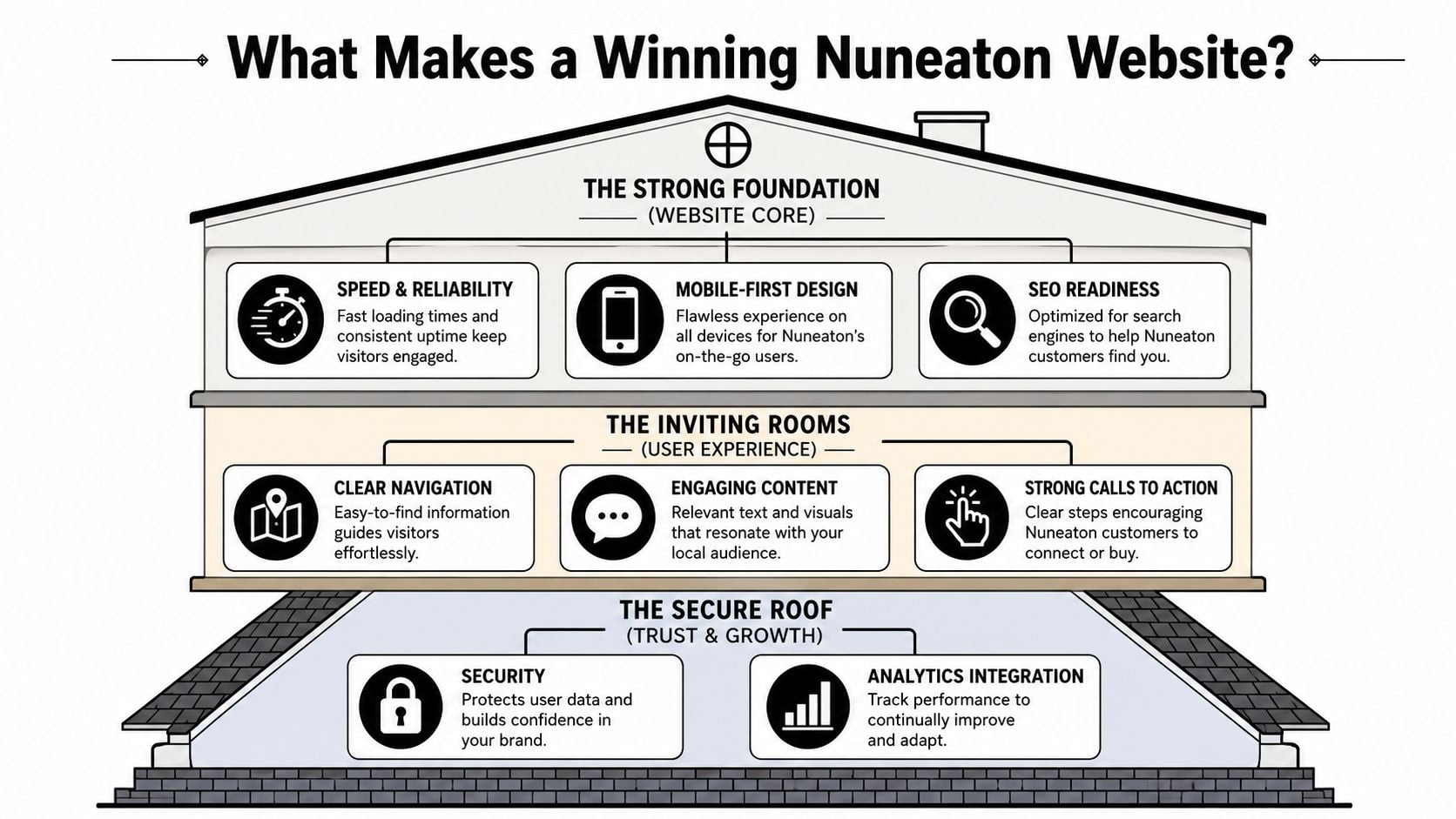
A Nuneaton customer lands on your website, needs an answer quickly, and decides within seconds whether to call you or try the next business. That decision usually has very little to do with fancy effects. It comes down to clarity, ease of use, trust, and whether the site helps people act without effort.
That is the standard your website needs to meet. A high-performing site should win enquiries, support your reputation, and give you fewer expensive gaps to fix later.
Your mobile experience decides whether people stay
Many Nuneaton business owners still review their website at a desk. Their customers do not. They find you on a phone while comparing quotes, checking opening times, or trying to solve a problem quickly.
If your mobile layout buries contact details, stacks content badly, or makes buttons awkward to tap, you lose leads before your sales process even starts.
A mobile-first build should give you:
- Immediate access to key actions such as calling, booking, or requesting a quote
- Clear, readable content without zooming or horizontal scrolling
- Simple page structure so services and prices are easy to scan
- Tap-friendly buttons and menus that work properly on smaller screens
Start there. Nice animations can wait.
The same principle applies to paid traffic too. A click from Google Ads is wasted if the landing page is clumsy, which is why layout, hierarchy, and speed matter so much when improving PPC performance with design.
Accessibility protects revenue and reduces legal risk
Accessibility is not a box-ticking exercise. It affects who can use your website, who gives up, and whether you expose the business to avoidable complaints.
The UK government's accessibility guidance sets out what websites should do to meet WCAG standards, including clear structure, keyboard access, readable contrast, and usable forms. If your site serves the public, you should treat those checks as part of the build, not an optional add-on.
That means covering practical details such as:
- Keyboard usability for visitors who cannot use a mouse
- Clear heading structure so pages make sense to screen readers
- Useful alt text on important images
- Proper form labels and error messages so people can complete enquiries
- Readable colour contrast in real-world conditions, not just in a design mock-up
A polished site can still block customers.
Accessibility also improves day-to-day usability for everyone. Clearer pages, cleaner forms, and better structure usually lead to more completed enquiries, fewer drop-offs, and less frustration. If you want to strengthen those basics, this guide to improving website user experience is a practical next read.
Clear pricing and content structure matter more than design trends
A website should answer the questions that stop people from contacting you. What do you do? Who is it for? What does it cost? Why should someone trust you? What should they do next?
Too many small business websites in Nuneaton hide the important bits behind vague copy and generic claims. That costs enquiries. Strong websites use direct service pages, plain-English calls to action, trust signals, and fixed-cost information where possible. Transparent pricing does not scare off good-fit customers. It filters out poor-fit ones and saves you time.
If you want better return from your website, build around three things. Clear journeys, accessible pages, and decisions you can measure properly over time. That is what turns a website into a business asset instead of a brochure.
The DesignStack Web Design Process Step by Step
A lot of business owners don't hate the idea of a new website. They hate the uncertainty around it. They don't want vague timelines, endless revisions, and silence between meetings.
A clear process fixes that. It gives you checkpoints, responsibilities, and fewer surprises.
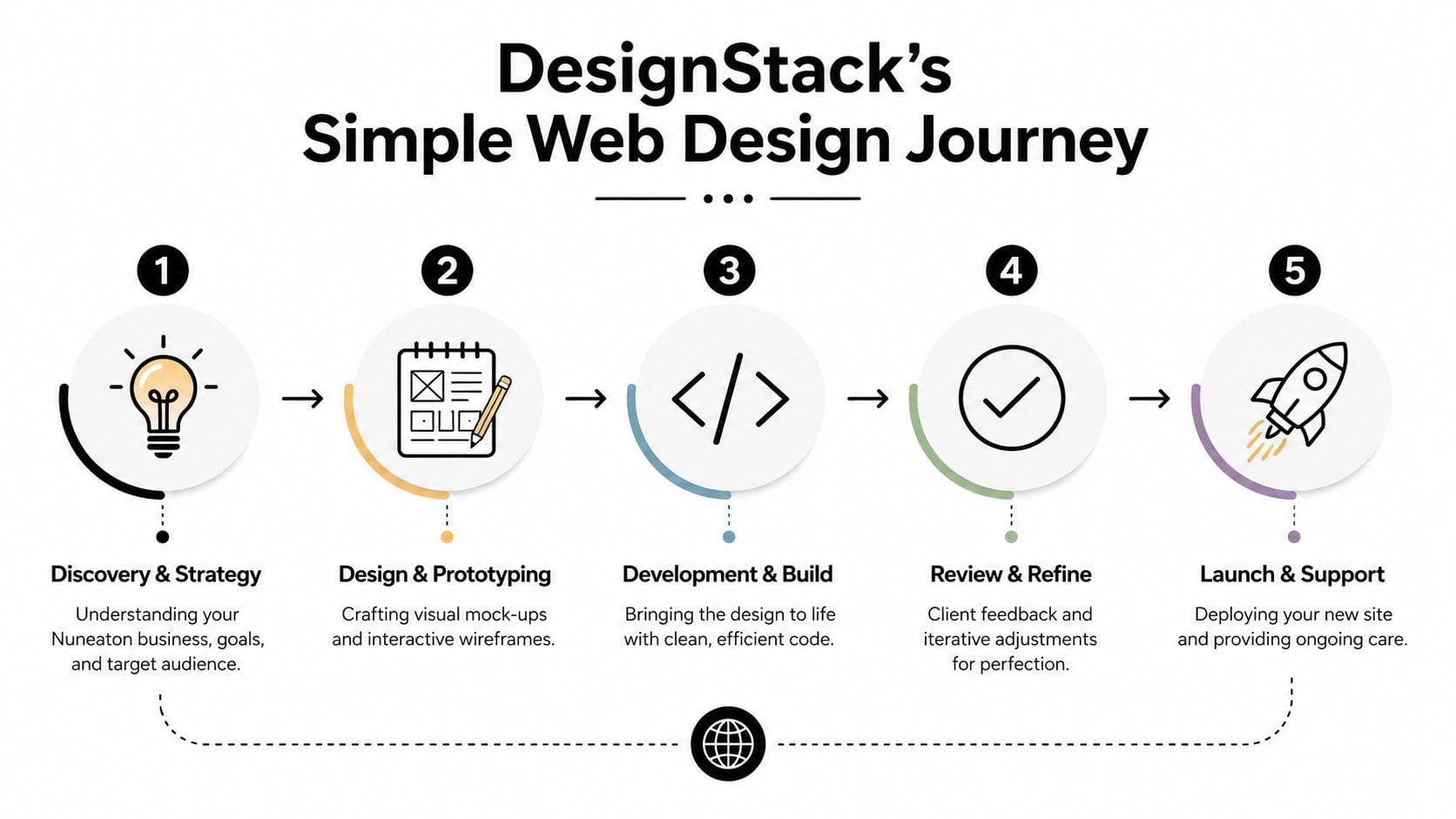
To make that easier to visualise, here's the process in a simple flow.
What happens first
The first step is discovery and strategy. At this stage, the right questions are more important than the visuals. What do you sell, who do you want to reach, what actions should people take, and what content already exists?
If an agency skips that and jumps straight to colours and layouts, be careful. You'll get a prettier version of the same confusion.
A sensible early phase usually includes:
Business goals
Your website has to support an outcome. More enquiries, better quality leads, easier bookings, stronger trust, simpler updates.Audience clarity
A site for a local restaurant works differently from one for a solicitor or an engineering firm.Page planning
You need the right pages, in the right order, with a clear journey between them.Wireframes
Before design starts, structure should be settled. If you're not familiar with that stage, this explanation of what a wireframe is in web design will make the process much clearer.
How the build moves from idea to launch
Once the structure is approved, the project should move into design and prototyping, then development and build, then review and refine, and finally launch and support.
That sequence matters because each stage solves a different problem.
- Design and prototyping turns strategy into a visual system. Branding, page layouts, and calls to action converge in this phase.
- Development and build makes the approved design functional. That includes responsive behaviour, CMS setup, forms, speed work, and technical testing.
- Review and refine gives the client room to catch issues before launch. Feedback should be focused and organised, not chaotic.
- Launch and support covers go-live checks, final content updates, and the fixes that always show up once real users start interacting with the site.
A short walkthrough often helps more than a long explanation, so it's worth seeing the process in motion:
What good process feels like: You always know what's being worked on, what's waiting on your feedback, and what happens next.
The practical benefit is simple. Better process leads to fewer delays, cleaner decisions, and a website that launches instead of drifting for months.
Our Core Website Services for Your Business
A good website should do three jobs for a Nuneaton business. It should help people take action, show you what is and is not working, and keep you out of avoidable legal and technical trouble. That is the standard. Anything less turns your site into a brochure that costs money and answers nothing.
WordPress for day-to-day control
WordPress is still the right choice for many local businesses because it keeps you in control of your own content. You should be able to update a service page, swap an image, change opening hours, or publish a case study without waiting on a developer.
That saves time and keeps the site current.
It also gives you room to grow without rebuilding the whole thing every year. A site with a stronger foundation and editable content is easier to expand when you add services, locations, landing pages, or lead magnets.
WordPress works well when you need:
- Editable page content your team can manage in-house
- Flexible page structure for service growth and campaign pages
- Useful integrations for forms, CRM tools, GA4, and SEO plugins
- Clear handover and training so the site stays maintained after launch
Lead generation, eCommerce, and tracking that tells the truth
Design alone does not grow a business. Measurement does.
If you cannot see which pages generate calls, quote requests, or sales, you are guessing. That is why proper GA4 setup should be part of the build, not an afterthought. Form submissions, phone click tracking, booking actions, and key page journeys need to be configured from day one so you can judge the site by results, not opinions.
For businesses selling online, the setup needs to do more than look trustworthy. It needs to remove friction and help staff manage orders without wasting time. That usually includes:
- Clear product and checkout journeys that reduce drop-off
- Secure hosting and SSL so buyers trust the site
- Fast page delivery and caching to keep pages responsive
- Usable product and order management for your internal team
- GA4 eCommerce tracking so you can see revenue, abandonment, and channel performance
If you are comparing providers, this small business website design guide gives a useful outside view of how hosting, design, and maintenance choices affect long-term performance.
Accessibility and compliance that protect the business
Accessibility is not a box-ticking exercise. It reduces legal risk, improves usability, and makes the site easier for more people to use. That means clear contrast, keyboard-friendly navigation, sensible heading structure, form labels that work properly, and content that screen readers can interpret.
WCAG standards matter here because they set a practical baseline for accessibility. If your website blocks people from reading, clicking, or completing a form, you lose business and create avoidable compliance risk.
Many businesses only hear about accessibility after launch, usually when fixing it costs more. Build it in from the start.
Search foundations and pricing clarity
Search performance starts with structure. Your page hierarchy, internal links, headings, service intent, metadata, and local relevance all shape how well the site performs. For a Nuneaton business, that means writing pages around real customer intent and local service demand, not stuffing locations into weak copy.
There is also a commercial point many agencies skip. Fixed-cost pricing usually beats vague estimates because you can judge ROI properly. If you want a realistic view of what different builds involve, this guide to website costs in the UK will help you compare scope against long-term value.
A website should give you clarity. On leads. On sales. On compliance. On cost. That is what makes it useful.
How Much Does Website Design in Nuneaton Cost?
This is the question most owners want answered first, and fair enough. The problem is that many agencies make pricing needlessly vague. You get “from” prices, half-scoped proposals, or hourly estimates that drift once the project starts.
A better way to think about cost is this. You're paying for strategy, content structure, design, development, testing, and post-launch reliability. The price rises when the project includes more pages, custom functionality, eCommerce, integrations, or detailed content support.
What usually affects price
The biggest pricing variables are usually practical, not mysterious.
- Project size matters because a five-page brochure site is a different job from a multi-service business site.
- Functionality changes the workload when you add booking systems, member areas, or online sales.
- Content readiness affects cost because messy or missing content slows everything down.
- Revision process influences time, especially when feedback is unclear or unstructured.
- Support after launch adds value because websites always need monitoring, updates, and adjustments.
If you want less financial risk, fixed-cost pricing is usually the smarter model. It gives you a defined scope and a clear expectation of what's included. That matters even more when you're budgeting for ongoing value, not just the initial build. For a fuller breakdown, this guide on how much a website costs in the UK is worth reading.
Estimated Website Design Costs for Nuneaton Businesses in 2026
These are practical budgeting ranges, not hard market rules. Exact costs depend on scope, complexity, and who's producing the content.
| Project Type | Description | Estimated Cost |
|---|---|---|
| Starter brochure site | A small website for a local business with core pages such as Home, About, Services and Contact | Lower investment range |
| Business website with CMS | A more robust site with editable content, stronger service structure, enquiry tracking, and clearer user journeys | Mid-range investment |
| eCommerce website | An online store with product setup, secure checkout, category structure, and order management | Higher investment range |
| Custom functionality project | A website with booking tools, integrations, portals, or tailored workflows | Premium investment range |
The right budget isn't the cheapest one. It is designed for the work your business needs. A cheap site that needs replacing again soon isn't good value.
Our Work With Businesses Like Yours
A Nuneaton business does not need a website built to impress other designers. It needs a site that helps the right people trust you, contact you, and take the next step.
Community and membership organisations
Community and membership websites have a harder job than many business sites. They need to speak clearly to members, partners, event visitors, sponsors, and new enquiries without becoming cluttered or confusing.
Work for organisations such as the Weymouth & Portland Chamber of Commerce shows what matters here. Clear page structure. Straightforward navigation. An admin setup your team can use. If staff or volunteers cannot update events, publish news, or keep key information current, the website quickly loses credibility.
That same pressure applies to organisations across Nuneaton. Your website represents the group in public, and it also has to work behind the scenes. Good design is only part of the job. The site also needs sensible content hierarchy, accessible layouts, and measurement in place so you can see which pages people use.
Retail and hospitality brands
Retail and hospitality websites live or die on clarity. A visitor should be able to find opening times, menus, products, booking options, pricing, and contact details without hunting for them.
Mobile use matters here, but the primary issue is not ticking a responsive design box. The core problem is lost action. If a page is awkward on a phone, people do not wait patiently. They leave. For a restaurant, café, shop, or local service brand, that means fewer calls, fewer bookings, and fewer walk-ins.
The better approach is practical. Build pages around the decisions customers are trying to make. Put the key information first. Keep journeys short. Track what happens with proper analytics so you know which pages drive enquiries and which ones need work.
If you want to see how that looks in practice, browse the DesignStack portfolio of web design projects. The useful part is not the visual style on its own. It is how each site is shaped around a commercial goal, a content problem, or a conversion bottleneck.
Strong portfolio work shows whether a team can solve the kind of business problems you already have.
Your Website Design Questions Answered
Do we need to meet in person
No. You can if it helps, but you don't need to.
A well-run web project works perfectly well remotely if communication is organised. That means a clear kickoff, structured feedback, agreed milestones, and regular updates. For many businesses, remote delivery is easier because decisions happen faster and nothing depends on diary gaps for travel.
How long does a website project take
It depends on content readiness, project complexity, and how quickly feedback comes back. Small brochure sites move faster than eCommerce or custom systems. The biggest delay in most projects isn't design or development. It's waiting on content, approvals, or unclear direction.
The simplest way to keep momentum is to appoint one decision-maker on your side. Too many voices slow everything down.
Do I need ongoing support after launch
Yes, if you want the site to stay useful.
Websites need updates, monitoring, content changes, and occasional fixes. Above all, they need review. Once people start using the site, patterns appear. Some pages work harder than others. Some buttons get ignored. Some forms confuse visitors. Without support, those issues sit there and cost you leads unnoticed.
What should I prepare before asking for a quote
You don't need a perfect brief, but you do need clarity on a few basics.
- Your main goal such as more enquiries, better leads, bookings, or online sales
- Your key services or products so the site can be structured properly
- Examples you like to show taste and expectations
- Any existing problems such as poor mobile use, weak messaging, or hard-to-update content
If you can explain what isn't working now, you're already in a good position.
If your current site looks acceptable but doesn't track results, support accessibility, or give you a clear return, it's time to fix the right things. DesignStack helps businesses build websites with fixed-cost pricing, clear process, and practical post-launch support, so you're not left with a pretty site that tells you nothing.

Leave a Reply